
Milviscutulus mangiferae
(Green, 1889)
Mango Shield Scale
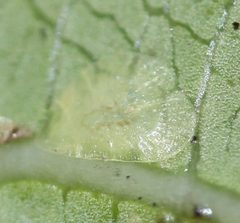
Milviscutulus mangiferae is a soft insect ( Coccidae) commonly known as the mango shield scale. It is a significant pest of mango (Mangifera indica) throughout tropical and subtropical regions. The exhibits kin-biased and shows variable across different mango varieties. First recorded in Australia in 2007, it has a broad global distribution across mango-growing regions.
Pronunciation
How to pronounce Milviscutulus mangiferae: /mɪl.vɪˈskjuː.tʊ.ləs mæŋˈɡɪfəˌriː/
These audio files are automatically generated. While they are not always 100% accurate, they are a good starting point.
Identification
Identified as a member of Coccidae by the combination of: soft, unarmored body covered with waxy secretions; presence of anal plates with associated anal ring setae; and reduced legs in females. Distinguished from other mango-feeding by -specific association with Mangifera indica and characteristic shield-like waxy covering formed by excreted honeydew and accumulation.
Images
Habitat
Tropical and subtropical mango orchards and gardens. Found on mango foliage, with highest densities reported on leaves of susceptible varieties.
Distribution
Native to South and Southeast Asia; introduced and established across tropical regions worldwide including: Africa (Egypt, Ghana, Kenya, Madagascar, Mauritius, Reunion, Seychelles, South Africa, Tanzania, Zanzibar), Asia (Bangladesh, Hong Kong, India, Indonesia, Israel, Japan, Malaysia, Pakistan, Philippines, Singapore, Sri Lanka, Taiwan, Thailand, Vietnam), Australia (north Queensland), Pacific Islands (Fiji, Palau, Papua New Guinea, Ryukyu Islands, Solomon Islands, Tonga, Western Samoa), and the Americas (Brazil, Colombia, Rica, Cuba, Dominican Republic, Ecuador, El Salvador, Honduras, Jamaica, Martinique, Mexico, Nicaragua, Panama, Puerto Rico, U.S. Virgin Islands, Venezuela).
Seasonality
In Egypt, active year-round with three peaks: January, June/July, and November. Continuous presence on evergreen mango allows uninterrupted development in suitable climates.
Diet
Phloem-feeding on mango (Mangifera indica). Extracts sap from vascular tissues of leaves, causing direct damage and excreting honeydew that supports growth.
Host Associations
- Mangifera indica - primary All records confirm mango as the sole significant ; variety-specific susceptibility documented with Ewaise as highly susceptible, Zebda and Fagri Kalan as susceptible, and Balady and Sakary as relatively
Behavior
Exhibits kin-biased , with related individuals showing non-random spatial patterns during of new plants. Sedentary females remain fixed on host foliage; mobile stage responsible for dispersal.
Ecological Role
Economic pest of mango production. Honeydew promotes growth, reducing photosynthetic capacity and fruit quality. No documented non-pest ecological role.
Human Relevance
Significant agricultural pest requiring monitoring and management in mango orchards. strategies benefit from knowledge of variety-specific susceptibility and seasonal peaks.
Similar Taxa
- Sternochetus mangiferaeShares mango and specific epithet, but is a weevil (Curculionidae) attacking fruit seeds rather than foliage; easily distinguished by and feeding damage type
- Other Coccidae on mangoRequires microscopic examination of taxonomic characters; M. mangiferae distinguished by combination of specificity, anal plate structure, and waxy covering
More Details
Kin-biased dispersal
Documented in a dedicated behavioral study, representing one of the few examinations of social dynamics in insect
Variety-specific management
Egyptian studies demonstrate that varies significantly among mango varieties, offering potential for cultural control within programs
Sources and further reading
- BugGuide
- GBIF taxonomy match
- iNaturalist taxon
- NCBI Taxonomy
- Catalogue of Life
- Quiz Yourself: 2020 Entomology Games Questions
- Kin-biased dispersal behaviour in the mango shield scale, Milviscutulus mangiferae
- Host preference of certain mango varieties to infestation with the mango shield scale, Milviscutulus mangiferae (Green) (Hemiptera: Coccidae) in Ismailia governorate, Egypt
- New records of mango shield scale Milviscutulus mangiferae (Green) (Hemiptera: Coccidae) and Brevennia rehi (Lindinger) (Hemiptera: Pseudococcidae) in north Queensland
- Pest categorisation of Milviscutulus mangiferae.