
Eulecanium
Cockerell, 1893
Species Guides
1- Eulecanium kunoense(kuno scale)
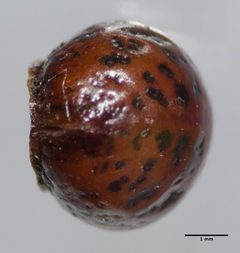
Eulecanium is a of soft scale insects ( Coccidae) comprising economically significant pests of fruit trees and ornamental plants. occur in Europe, Asia, North America, and Australia. Several species are and have been introduced outside their native ranges, with some becoming subjects of programs. The genus includes morphologically similar species that often require molecular or microscopic examination for accurate identification.
Pronunciation
How to pronounce Eulecanium: /juːləˈkeɪniəm/
These audio files are automatically generated. While they are not always 100% accurate, they are a good starting point.
Identification
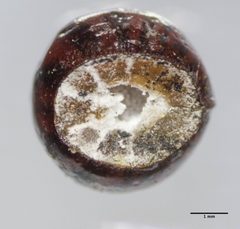
-level identification within Eulecanium is challenging due to morphological similarity; distinguishing characteristics are often only visible in slide-mounted young females. Molecular markers (mitochondrial COI and 28S rDNA) provide reliable separation of at least some species pairs. Adults are relatively large for soft scales, with E. excrescens reaching up to 13 mm long and 8–10 mm high.
Images
Habitat
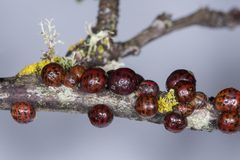
occupy deciduous orchard and ornamental trees. Nymphs and occur on leaves during part of the , then migrate to woody parts (twigs, branches) in autumn; nymphs specifically overwinter on twigs.
Distribution
distributed across Europe, Asia (China, Japan), North America, and Australia. Specific distributions vary: E. excrescens occurs in USA, China (Sichuan), and UK; E. coryli introduced to British Columbia from England; E. rugulosum recorded in Turkey; E. giganteum and E. kuwanai mainly in China.
Seasonality
Activity patterns vary by . E. excrescens completes one per year: nymphs overwinter on twigs, mature in late spring, lay in May, with first instars appearing late May–June.
Diet
Phloem-sap feeding. feed on diverse deciduous orchard and ornamental trees including maple (Acer), apple (Malus), stone fruits (Prunus), walnut (Juglans), wisteria, and pistachio (Pistacia).
Life Cycle
(one per year) in where documented. Development includes , three nymphal instars, and stages. E. excrescens females lay approximately 2000 eggs. likely parthenogenetic in at least some species (no male stages observed in E. excrescens in UK studies).
Behavior
Nymphs feed on leaves during part of the growing season, then migrate to woody parts in autumn before leaf fall, becoming sedentary on twigs through winter. and nymphs excrete honeydew, promoting growth on plants. Heavy cause stems to become thickly encrusted with .
Ecological Role
Phytophagous pests causing plant weakening, leaf loss, dieback, reduced , and aesthetic deterioration through accumulation. Some support (Encyrtidae), serving as for agents.
Human Relevance
Several are economically significant agricultural and horticultural pests. E. coryli caused severe injury to maple and horse chestnut in British Columbia before successful . E. excrescens is subject to EU phytosanitary concern as a potential pest. Chemical control has proven difficult with transitory effects; biological control using (Blastothrix spp.) has achieved high success rates (90–100% documented).
Similar Taxa
- ParthenolecaniumBoth are of soft scales (Coccidae) with similar and life habits; microscopic examination of females required for separation.
- LecaniumHistorically confused taxonomically; some Eulecanium were formerly placed in Lecanium. Slide-mounted specimens needed to distinguish based on morphological characters of females.
Sources and further reading
- BugGuide
- Wikipedia
- GBIF taxonomy match
- iNaturalist taxon
- NCBI Taxonomy
- Catalogue of Life
- Pest categorisation of Eulecanium excrescens
- New Parasitoids Records of Eulecanium rugulosum (Archangelskaya, 1937) (Hemiptera: Sternorrhyncha: Coccoidea: Coccidae) for Diyarbakır Diyarbakır için Eulecanium rugulosum’un (Archangelskaya, 1937) (Hemiptera: Sternorrhyncha: Coccoidea: Coccidae) yeni kayıt parazitoidleri
- Studies of the Lecanium Scale, Eulecanium coryli (L.), and its Parasite, Blastothrix sericea (Dalm.), in British Columbia
- Molecular identification of two morphologically similar Eulecanium species: E. giganteum and E. kuwanai (Hemiptera: Coccidae)