
Tamalia coweni
(Cockerell, 1905)
Manzanita leaf gall aphid, Fold-gall aphid
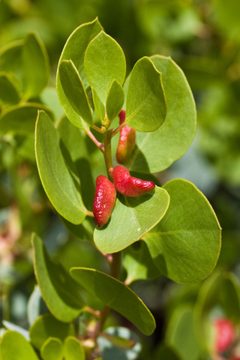
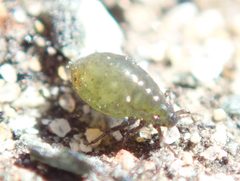
Tamalia coweni is a gall-inducing that forms leaf galls on manzanita (Arctostaphylos), primarily affecting glabrous manzanitas. The species produces two distinct gall types: midrib or margin leaf galls, which are common, and less frequent inflorescence galls. Multiple individuals occupy galls communally rather than maintaining solitary structures. The species serves as for the aphid Tamalia inquilina and as prey for specialized dipteran .
Pronunciation
How to pronounce Tamalia coweni: //təˈmɑːliə ˈkaʊəni//
These audio files are automatically generated. While they are not always 100% accurate, they are a good starting point.
Identification
Distinguished from other Tamalia by its association with glabrous manzanita species and production of two gall types: leaf galls (midrib or margin) and occasional inflorescence galls. Distinguished from the Tamalia inquilina, which inhabits existing galls without inducing them. Distinguished from Tamalia glaucensis, which specifically induces galls on big-berry manzanita (Arctostaphylos glauca).
Images
Habitat
Galls on leaves and inflorescences of glabrous manzanita trees (Arctostaphylos ). Documented specifically on greenleaf manzanita (Arctostaphylos patula) in Shasta County, California, and on Arctostaphylos insularis.
Distribution
Pacific coast of North America, extending eastward to Nevada and Colorado. Documented collection sites in Shasta County, California.
Diet
Phloem sap of manzanita (Arctostaphylos).
Host Associations
- Arctostaphylos patula - gall greenleaf manzanita; documented in Shasta County, California
- Arctostaphylos insularis - gall documented for gall induction
- Arctostaphylos species - gall most of glabrous manzanita
Life Cycle
Forms galls on plant tissues with communal occupation by multiple individuals. Meiotic system involves a univalent X .
Behavior
Induces galls on plant tissues; exhibits communal gall occupation where multiple females share gall structures. Coexists with other within galls, including two obligate predatory dipterans that partition the resource through different exploitation strategies.
Ecological Role
Similar Taxa
- Tamalia inquilina that obligately inhabits galls induced by T. coweni without forming its own galls; genetically closely related but distinguished by lacking gall-inducing ability
- Tamalia glaucensisRecently described that induces leaf galls specifically on big-berry manzanita (Arctostaphylos glauca), whereas T. coweni uses most glabrous manzanita species
More Details
Genetic differentiation
of T. coweni from different plants are very closely related to one another, with minimal genetic differentiation across host . This contrasts with its T. inquilina, which shows strong genetic differentiation among host plants.
Sources and further reading
- BugGuide
- Wikipedia
- GBIF taxonomy match
- iNaturalist taxon
- NCBI Taxonomy
- Catalogue of Life
- Lessons from the Ants | Bug Squad
- ARTHROPODS ASSOCIATED WITH A MANZANITA GALL INDUCED BY THE APHIDTAMALIA COWENI(COCKERELL) (HOMOPTERA: APHIDIDAE)
- Influence of Host Phenology and Vegetation on the Abundance of Tamalia coweni Galls (Homoptera: Aphididae) on Arctostaphylos insularis (Ericaceae)
- Life history, ecology and communal gall occupation in the manzanita leaf-gall aphid,Tamalia coweni(cockerell) (Homoptera: Aphididae)
- A cytological and experimental analysis of the meiotic behavior of the univalent X chromosome in the bearberry aphid Tamalia (Phyllaphis) coweni (Ckll.)
- The evolution of inquilinism, host-plant use and mitochondrial substitution rates in Tamalia gall aphids