
Pemphigus spyrothecae
Passerini, 1860
Poplar Spiral Gall Aphid
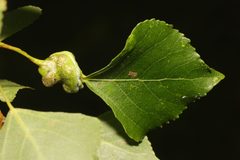
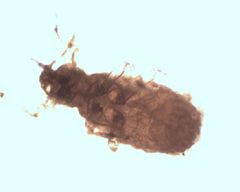
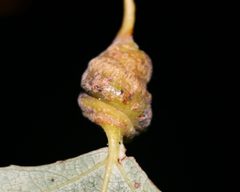
Pemphigus spyrothecae is a gall-forming that induces distinctive spiral-shaped galls on leaf petioles of Populus nigra. The exhibits eusocial with a sterile soldier comprising first-instar nymphs with thickened hind legs that defend the colony against . Colony defense includes fortress defense, gall repair, and maintenance of colony hygiene. The aphid has a with four : fundatrix, virginoparae, sexuparae, and sexual males and females. Genetic relatedness within galls is high due to clonal , with clonal mixing averaging 0.68-10.4% across .
Pronunciation
How to pronounce Pemphigus spyrothecae: //ˈpɛmfɪɡəs ˌspaɪroʊˈθiːkiː//
These audio files are automatically generated. While they are not always 100% accurate, they are a good starting point.
Identification
Distinguished from other Pemphigus by the spiral-shaped gall formed on leaf petioles of Populus nigra, rather than on leaves or stems. The gall's distinctive snail-shell spiral with multiple turns is unique to this species. First-instar nymphs with thickened hind legs indicate the soldier . Galls mature in late August to early September, changing from green to red. migrants exit through small pores along the spiral seams.
Images
Habitat
Urban green areas and natural on black poplar trees (Populus nigra), particularly the 'Italica' variety. Galls form on leaf petioles. Sexual stages occur in bark crevices of the tree.
Distribution
Europe, North Africa (Tunisia), western Siberia, Pakistan, and some locations in Canada. Specific studied in detail in the UK, Italy, Poland, and other European locations.
Seasonality
Fundatrix emerges from in spring. Gall closure occurs late April to early May. Fundatrix matures by end of May. Second appears late May to early June. Virginoparae mature late July to August. sexuparae peak in late August. Aphids observed in galls until end of October.
Diet
Phloem sap from leaf petioles of Populus nigra. Sexual stages do not feed.
Host Associations
- Populus nigra L. - primary Black poplar, particularly variety 'Italica'. Fundatrix induces spiral galls on leaf petioles; occurs on bark.
Life Cycle
Holocyclic with four : (1) Fundatrix emerges from fertilized , induces spiral gall on petiole, reproduces parthenogenetically and viviparously; (2) offspring develop into virginoparae; (3) virginoparae produce sexuparae; (4) sexuparae migrate to bark, produce males and females which mate; fertilized females lay single wax-covered egg in bark crevices. First-instar soldiers are produced within galls and comprise approximately half the colony .
Behavior
Exhibits eusocial with sterile soldier . First-instar soldiers defend the gall through fortress defense, attacking with stylets and thickened hind legs. Soldiers also repair gall openings and maintain colony hygiene. Defense is costly: soldiers may die during attacks. Soldiers are positioned closer to gall openings, while reproductives occupy inner areas. Altruistic defense is more likely in high-quality galls that are difficult to obtain. Sexuparae aggregate on bark in small groups before giving birth to ensure mating opportunities.
Ecological Role
Gall formation significantly alters plant leaf architecture, reducing leaf length, width, and area. feeding manipulates host plant physiology by increasing hydrogen peroxide and electrolyte leakage in gall tissues while suppressing host defense responses (decreased malondialdehyde content and antioxidant activities). This physiological manipulation benefits the aphid at the expense of host plant . Gall presence affects photosynthetic characteristics and foliage chemistry of Populus nigra.
Human Relevance
Primarily of scientific interest for studying the evolution of eusociality and in insects. Not a significant agricultural pest. Occasionally referenced in misidentifications of root aphids on cannabis crops, though P. spyrothecae is not associated with this .
Similar Taxa
- Pemphigus dorocolaAlso produces first-instar soldiers with defensive ; distinguished by gall location and
- Rhopalosiphum rufiabdominale (rice root aphid)Often misidentified in online discussions of 'root aphids' on cannabis; P. spyrothecae forms above-ground spiral galls on poplar, not root
- Other Pemphigus speciesForm galls on different plant parts (leaves, stems, roots) with different shapes; P. spyrothecae uniquely forms spiral petiole galls
Misconceptions
Internet sources frequently misidentify Pemphigus spyrothecae or use its images when discussing 'root aphids' on cannabis crops. This does not infest cannabis or roots; it forms distinctive spiral galls above ground on poplar petioles. True root aphids on cannabis are typically Rhopalosiphum rufiabdominale or other species.
More Details
Soldier caste evolution
The soldier has evolved independently at least four times in aphids. In P. spyrothecae, soldiers are first-instar nymphs that can attack with a single thrusting motion of their stylets, sometimes using all six legs to squeeze and rupture predator . All migrants from galls are wingless first-instar soldiers, suggesting soldiers evolved from specialized migrants.
Genetic relatedness and altruism
High genetic relatedness within galls (average mixing 0.68-10.4%) supports as the primary explanation for altruistic soldier . However, soldiers do not defend against non- immigrants of the same , despite their presence in galls.
Mating system
involves intense male-male competition and post-copulatory mate-guarding. Sex ratio is female-biased with approximately 1 male per 2.5 females born. Males can mate with up to 14 females; females are receptive to remating for only 15-20 minutes after first mating.
Sources and further reading
- BugGuide
- Wikipedia
- GBIF taxonomy match
- iNaturalist taxon
- NCBI Taxonomy
- Catalogue of Life
- Rice Root Aphid: An Insect Surprise on Indoor-Grown Cannabis
- Clonal mixing in the soldier‐producing aphidPemphigus spyrothecae(Hemiptera: Aphididae)
- Sex ratio, local mate competition and mating behaviour in the aphid Pemphigus spyrothecae
- Poplar Tree Response to Feeding by the Petiole Gall Aphid Pemphigus spyrothecae Pass