
Pemphigus obesinymphae
Aoki & Moran, 1994
Cherubic Poplar Petiole-gall Aphid
Pemphigus obesinymphae is a gall-forming that induces galls on the leaves of Populus fremontii. It is notable as the only North American aphid known to produce soldier —specialized first-instar nymphs that actively defend the colony. The species was described by Aoki & Moran in 1994 and belongs to the Pemphigus, which contains many gall-forming aphids associated with poplar and cottonwood species.
Pronunciation
How to pronounce Pemphigus obesinymphae: //ˈpɛm.fɪ.ɡəs oʊˌbiːsaɪˈnɪm.fi//
These audio files are automatically generated. While they are not always 100% accurate, they are a good starting point.
Identification
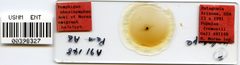
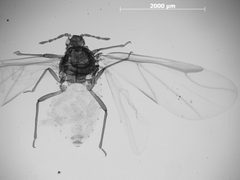
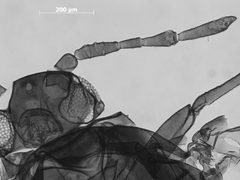
This can be distinguished from other Pemphigus species by its association with galls on Populus fremontii leaves rather than petioles or stems. The presence of soldier —first-instar nymphs with enlarged hind legs and defensive —is a unique trait among North American aphids and serves as a diagnostic feature. Morphological details of the gall structure and nymphal characteristics require examination for definitive identification.
Images
Habitat
Associated with riparian and floodplain environments where the tree Populus fremontii (Fremont cottonwood) occurs. Galls are formed on the leaves of this host .
Distribution
North America; distribution corresponds to the range of its Populus fremontii, which is found in the southwestern United States and northern Mexico.
Diet
Feeds on phloem sap of Populus fremontii. Like other aphids, it uses to extract plant fluids.
Host Associations
- Populus fremontii - gall-forming herbivoreForms galls on leaves; sole known
Behavior
Ecological Role
Gall formation modifies leaf tissue of the tree, potentially affecting photosynthetic capacity at the local level. The serves as prey for various and , though its soldier provides colony defense.
Similar Taxa
- Other Pemphigus speciesMany Pemphigus form galls on Populus species, but P. obesinymphae is distinguished by its leaf-gall formation on P. fremontii and its unique soldier among North American members of the .
- Rhopalosiphum rufiabdominaleOften confused in general discussions of 'root aphids' on poplars and other plants; however, this is a root-feeding without gall formation and belongs to a different .
Misconceptions
More Details
Eusociality in aphids
The soldier of P. obesinymphae represents one of the few known examples of eusociality in aphids. These soldiers are morphologically distinct first-instar nymphs that attack using their enlarged hind legs and can sacrifice themselves through a process involving body rupture.