
Pemphigus bursarius
(Linnaeus, 1758)
lettuce root aphid, poplar gall aphid
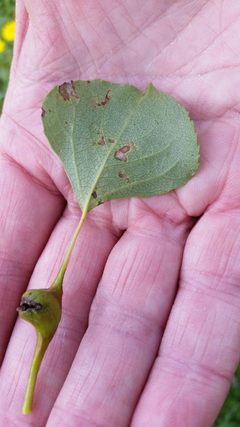
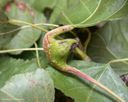
is a -alternating with a involving Populus as primary hosts and Asteraceae (particularly lettuce) as secondary hosts. On poplars, it forms flask-shaped leaf-stalk galls in spring; on secondary hosts, it lives subterraneanly feeding on roots. The species exhibits unusual flexibility in its , with some capable of in soil without returning to the primary host. It is an economically significant pest of lettuce crops and shows genetically distinct host-associated populations.
Pronunciation
How to pronounce Pemphigus bursarius: //ˈpɛmfɪɡəs bərˈsɛəriəs//
These audio files are automatically generated. While they are not always 100% accurate, they are a good starting point.
Identification
Distinguished from the similar Pemphigus spirothecae (which forms spiral galls on poplars) by gall : P. bursarius produces flask-shaped (pouch-like) galls on leaf stalks, while P. spirothecae forms spiral galls. Early instar fundatrices of both are easily confused. On secondary , identification requires examination of morphological features or molecular methods; subterranean lifestyle distinguishes it from foliage-feeding aphids. Genetically distinct occur on different secondary host species (Lactuca sativa, Matricaria inodora, Lapsana communis), which may represent host races or cryptic species.
Images
Appearance
Small, soft-bodied with typical pear-shaped body form. Coloration varies by morph and life stage. Fundatrices and gall-dwelling stages found within distinctive flask-shaped galls on poplar petioles. (winged) forms possess two pairs of membranous wings. (wingless) forms occur on roots of secondary . Sexuparae (migratory forms) are winged and produced for autumn back to primary host.
Habitat
Primary : leaf-stalk galls on Populus (poplars) during spring gall phase. Secondary habitat: soil and root systems of herbaceous Asteraceae, particularly lettuce (Lactuca sativa), endive, and carrot (Daucus carota), where it lives exclusively underground. Capable of asexually in soil even after plant death. Thrives in cultivated agricultural settings and natural on wild Asteraceae.
Distribution
Recorded from Belgium (Flemish Region, Walloon Region, Brussels-Capital Region) and São Miguel (Azores). Significant documented in Germany (Federal Republic). Present in North America (California). Distribution likely broader across temperate regions where poplars and cultivated Asteraceae co-occur, but precise range requires further documentation.
Seasonality
Fundatrices hatch from on poplars in spring. Gall development occurs during spring months. to secondary takes place in summer. Sexuparae (return migrants) produced in autumn for migration back to poplars; timing influenced by temperature and . Some remain on secondary hosts year-round through overwintering. Optimal temperatures for : approximately 60°F (15.5°C) for fundatrigeniae, 55°F (12.8°C) for sexuparae.
Diet
Phloem sap feeder. On primary (Populus): feeds within galls on petiole phloem. On secondary hosts: feeds on root phloem of Lactuca sativa (lettuce), Daucus carota (carrot), and other Asteraceae. Electronic monitoring confirms distinct feeding including stylet activities, salivary secretions, intracellular penetrations, and phloem ingestion (E1 and E2 phases). Feeding success varies dramatically by host plant variety; lettuce varieties deter phloem penetration.
Host Associations
- Populus nigra - primary and gall formation; specific identification from genetic studies
- Populus - primary Gall formation on petioles; multiple may be used
- Lactuca sativa - secondary Major agricultural ; cyclically parthenogenetic genetically distinct
- Matricaria inodora - secondary Obligate parthenogens or possibly distinct based on genetic data
- Lapsana communis - secondary Mixture of cyclical and obligate parthenogens; higher genetic heterogeneity
- Daucus carota - secondary Root feeding documented
Life Cycle
Heteroecious (-alternating) with both sexual and parthenogenetic phases. Sexual phase: occurs on primary host Populus, producing . Parthenogenetic phase: on secondary hosts (Asteraceae roots). Fundatrices (founding females) hatch in spring, induce galls, and produce offspring within galls. fundatrigeniae migrate to secondary hosts in summer, establishing root colonies through . In autumn, sexuparae (winged forms) are produced; these migrate back to poplars to produce sexual forms (oviparae and males) and overwintering eggs. Alternative : some apterae (wingless forms) do not produce sexuparae but overwinter asexually in soil, surviving host plant death and colonizing new plants the following spring—enabling indefinite persistence without .
Behavior
Subterranean existence on secondary makes detection difficult. Gall-dwelling on primary host involves inducing flask-shaped petiole galls through feeding. Defensive behaviors include production of soldier morphs (documented in related studies). When galls open at time, rapid departure or vulnerability to occurs. Apterae on secondary hosts show temperature- and -dependent morph determination: 20°C with long day (18:6) produces ~50% apterae, while 15°C with 12:12 photoperiod induces alatae formation. Successive in alatae-inducing conditions show increasing apterae production, indicating phenotypic plasticity.
Ecological Role
Herbivore inducing plant galls on primary and consuming root phloem on secondary hosts. Prey for diverse natural enemy complex including: Anthocoris nemorum and A. nemoralis (Anthocoridae) as major gall ; syrphid larvae; coccinellids attacking sexuparae; staphylinid and carabid beetles associated with subterranean colonies; chloropid larvae Thaumatomyia glabra and T. notata as soil predators. Hyperparasitoid Pachyneuron sp. (Pteromalidae) attacks parasitized fundatrices. rates are low compared to foliage-feeding aphids. Host-associated genetic differentiation suggests potential for ecological speciation.
Human Relevance
Significant agricultural pest of lettuce (Lactuca sativa), causing direct damage through root feeding that retards plant growth and reduces yield. Also reported on carrot and endive crops. Root-feeding habit complicates detection and management. lettuce varieties exist (Lakeland, Grand Rapids, Avoncrisp, Avondefiance) that deter phloem penetration. Frequently misidentified in internet discussions about "root aphids," particularly in cannabis where it has been confused with Rhopalosiphum rufiabdominale and other . Management requires approaches targeting soil-dwelling stages.
Similar Taxa
- Pemphigus spirothecaeAlso forms galls on Populus and easily confused in early instars; distinguished by spiral gall versus flask-shaped galls of P. bursarius
- Rhopalosiphum rufiabdominaleAnother root-feeding frequently misidentified as P. bursarius in agricultural settings, particularly in cannabis ; distinguished by range and morphological features
Misconceptions
Commonly misidentified in internet and grower discussions about "root aphids," particularly in indoor cannabis , where it has been confused with Rhopalosiphum rufiabdominale and even grape phylloxera (Daktulosphaira vitifoliae). The subterranean habit leads to delayed detection and misattribution of plant . Not all require return to poplar for — soil overwintering was historically underappreciated.
More Details
Genetic Structure
-associated show significant genetic differentiation. Populations on Lactuca sativa are distinct cyclical parthenogens; those on Matricaria inodora may represent obligate parthenogens or a separate ; Lapsana communis populations show mixed reproductive strategies with higher genetic heterogeneity possibly due to founder effects.
Feeding Behavior Research
Electronic penetration graph (EPG) studies demonstrate that lettuce varieties (Avoncrisp, Avondefiance) prevent probing entirely or cause rapid termination of penetration, while moderately resistant varieties (Lakeland, Grand Rapids) allow probing but deter sustained phloem ingestion.
Natural Enemy Ecology
Anthocoris nemorum and A. nemoralis kill all aphids within a gall extremely rapidly upon entry, possibly using stink gland secretions as in the confined gall space. This represents a distinctive -prey interaction not seen in open-feeding aphids.
Sources and further reading
- BugGuide
- GBIF taxonomy match
- iNaturalist taxon
- NCBI Taxonomy
- Catalogue of Life
- Rice Root Aphid: An Insect Surprise on Indoor-Grown Cannabis
- Host-associated populations in the lettuce root aphid, Pemphigus bursarius (L.)
- Untersuchungen zur Biologie der Salatwurzellaus Pemphigus bursarius (L.)1
- The natural enemies of the lettuce root aphid, Pemphigus bursarius (L.).
- THE EFFECT OF TEMPERATURE ON REPRODUCTION BY THE ALATAE OF PEMPHIGUS BURSARIUS (L.)
- Defensive Behavior in Primary- and Secondary-Host Generations of the Soldier-Producing Aphid, Pemphigus bursarius (Hemiptera: Aphididae)
- Seasonal Development and Emergence of Two Species of Gall-Forming Aphids, Pemphigus bursarius and P. nortoni, Associated with Poplar Trees in California
- The influence of host plant on the production of sexuparae in the aphid Pemphigus bursarius
- THE SURVIVAL IN SOIL OF APTERAE OF THE LETTUCE ROOT APHID, PEMPHIGUS BURSARIUS (L.)
- Completion of the biology of the Aphides of the galls of the poplar (Pemphigus bursarius, Linn)
- Population genetic structure of the lettuce root aphid, Pemphigus bursarius (L.), in relation to geographic distance, gene flow and host plant usage
- Electronically monitored feeding behaviour of the lettuce root aphid (Pemphigus bursarius) on resistant and susceptible lettuce varieties
- Escaping an ecological dead‐end: asexual overwintering and morph determination in the lettuce root aphid Pemphigus bursarius L.