
Melaphis rhois
(Fitch, 1866)
Staghorn sumac aphid, Sumac gall aphid
Melaphis rhois is a woolly aphid that induces distinctive galls on sumac leaves (Rhus typhina and R. glabra). It was first described by Asa Fitch in 1866 and has a complex involving alternation between sumac and moss . The is part of a cryptic ; molecular and morphometric analyses have revealed at least three sympatric species in North America previously grouped under this name. It exhibits exceptionally low genetic diversity and pronounced structure due to restricted among isolated galls.
Pronunciation
How to pronounce Melaphis rhois: /ˈmɛləfɪs ˈroʊɪs/
These audio files are automatically generated. While they are not always 100% accurate, they are a good starting point.
Identification
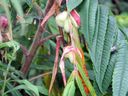
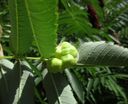
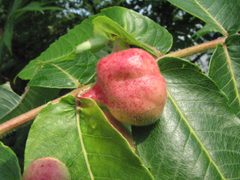
The is identified by its association with characteristic galls on sumac leaves: pouch-like structures (often red-tinged) on the leaf underside formed when a female induces the leaf tissue to grow over a single offspring. However, positive identification requires molecular or detailed morphometric analysis due to the existence of cryptic (including M. asafitchi) that are morphologically similar and sympatric.
Images
Appearance
A woolly aphid covered in dense, waxy filaments. Winged females are produced in late summer for to alternate . Sexual females exhibit ovoviviparity, giving birth to live young rather than laying in some stages.
Habitat
Found on staghorn sumac (Rhus typhina) and smooth sumac (R. glabra) in eastern North America during spring and summer. Winged stages migrate to moss, where colonies establish on the alternate through late season.
Distribution
Eastern North America, centered in regions where sumacs (Rhus typhina, R. glabra) occur. Documented from Ontario and Quebec through the northeastern and midwestern United States. GBIF records from Great Britain are present but require verification; records from Belgium and France are marked doubtful.
Seasonality
Active on sumac in spring and summer. Winged females leave galls in late summer to migrate to moss. and recolonization of sumac occurs each spring.
Diet
Phloem feeder on sumac (Rhus typhina, R. glabra) during gall phase, and on moss during alternate phase.
Host Associations
- Rhus typhina - primary staghorn sumac; gall formation occurs on leaves
- Rhus glabra - primary smooth sumac
- Moss (Bryophyta) - alternate specific moss not identified in available sources; colonies established by winged migrants in late summer
Life Cycle
Complex with alternation. Sexual females reproduce via ovoviviparity, producing a single offspring that is deposited on sumac leaf underside. This offspring induces gall formation and proliferates clonally via within the gall. Winged females emerge in late summer and fly to moss, establishing colonies that eventually produce sexual males and females. These sexual forms recolonize sumac each spring. The has been documented maintaining this host alternation pattern for approximately 48 million years.
Behavior
Females induce gall formation by chemical or physical stimulation of sumac leaf tissue when depositing offspring. Parthenogenetic remain enclosed within the protective gall structure. Limited occurs among galls; show genetic isolation and inbreeding. Winged morphs are produced specifically for switching to moss.
Ecological Role
Forms a gall that provides protected microhabitat for multiple parthenogenetic . Considered inconsequential to plant health despite parasitic relationship. No commercial value compared to other gall-forming insects such as the Chinese gall .
Human Relevance
Subject of scientific interest due to its ancient and stable insect-plant relationship (48 million years), one of the oldest documented examples. Used in studies of genetic diversity, cryptic speciation, and evolution of alternation. No economic importance; galls have no commercial value.
Similar Taxa
- Melaphis asafitchiCryptic described from North America, sympatric with M. rhois and requiring molecular or morphometric analysis for differentiation
- Melaphis minutaHistorical name that cannot be assigned to either M. rhois or M. asafitchi; represents another potentially distinct in the complex
- Other Fordini gall aphidsShare woolly appearance and gall-forming habit on woody plants, but differ in specificity and gall
Misconceptions
The iNaturalist and Wikipedia sources incorrectly state that M. rhois is the only in the Melaphis. Research published in 2017 demonstrated this is a cryptic containing at least three species.
More Details
Cryptic speciation
Molecular and morphometric analyses indicate that what was historically called M. rhois comprises at least three sympatric cryptic in North America. The name M. rhois has been redefined with a neotype designated to stabilize .
Genetic attributes
Exhibits exceptionally low genetic diversity comparable to pest aphids, despite not being a pest . show frequent heterozygote deficits indicating inbreeding, and pronounced gene frequency divergence among populations due to restricted .
Evolutionary significance
The sumac-moss alternation pattern has been maintained for approximately 48 million years based on fossil evidence, representing one of the oldest documented insect-plant relationships when first identified in 1989.