
Fordini
Acloque, 1897
Genus Guides
3- Forda
- Melaphis(staghorn sumac aphid)
- Smynthurodes
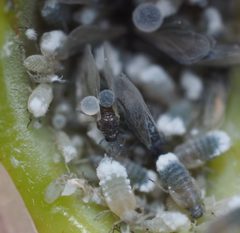
Fordini is a monophyletic tribe of gall-forming aphids (Hemiptera: Aphididae) characterized by complex two-year , strict specificity, and sophisticated plant manipulation abilities. The tribe comprises two subtribes: Fordina, associated with Pistacia and producing spherical to cauliflower-like galls; and Melaphidina, associated with Rhus species with galls positioned on leaf midribs and petioles. These aphids alternate between primary woody hosts where they induce conspicuous galls and secondary grass hosts where they feed on roots.
Pronunciation
How to pronounce Fordini: //fɔɹˈdiːnaɪ//
These audio files are automatically generated. While they are not always 100% accurate, they are a good starting point.
Identification
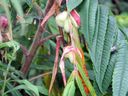
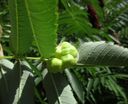
Fordini can be distinguished from other tribes by their gall-forming habit combined with specificity for Anacardiaceae (Pistacia or Rhus). Within the tribe, subtribes are separated by host : Fordina on Pistacia, Melaphidina on Rhus. Gall provides additional diagnostic characters: Fordina produce small bag-like to large spherical or cauliflower-shaped galls, often with location changes or two galls per ; Melaphidina species produce galls that shift position from leaflet midrib to petiole to compound leaf petiole. Species-level identification requires examination of multiple morphs due to high within life cycles.
Images
Habitat
Galls on primary plants (Pistacia shrubs for Fordina; Rhus for Melaphidina); root-feeding on secondary Poaceae hosts. Galls occur on various plant parts depending on species: leaflets, petioles, or common petioles of compound leaves. Mediterranean and subtropical regions with suitable host plant distributions.
Distribution
Mediterranean region including Iberian Peninsula, Israel, and Canary Islands; broader distribution encompasses areas where Pistacia and Rhus occur. Specific range varies by subtribe and species.
Seasonality
Two-year with seasonal alternation between primary and secondary . Gall formation occurs on Pistacia or Rhus during specific phases; root-feeding on grasses occurs during alternate phase.
Diet
Phloem-feeding on plants; induces strong metabolic sinks in host tissue to enhance nutrient acquisition. Primary hosts: Pistacia (Fordina) and Rhus species (Melaphidina). Secondary hosts: Poaceae roots.
Host Associations
- Pistacia - primary Shrubs in Anacardiaceae; for subtribe Fordina. Specific associations include P. atlantica, P. terebinthus, and P. lentiscus.
- Rhus - primary for subtribe Melaphidina.
- Poaceae - secondary Root-feeding for alternate phase of .
Life Cycle
Complex two-year cycle alternating between primary woody and secondary grass host. On primary host: induces gall formation, often with multiple morphs produced. Some Fordina form two distinct galls during their . High with many morphs per species complicates life cycle elucidation for some .
Behavior
Gall induction through sophisticated plant manipulation, creating strong metabolic sinks that redirect host resources to colonies. Evolutionary trend toward enhanced host manipulation abilities and increased gall complexity. Different produce morphologically distinct galls on different plant parts.
Ecological Role
Gall-former creating distinctive plant structures on Pistacia and Rhus; likely influences local plant dynamics through resource diversion and provision of microhabitats for associated organisms.
Similar Taxa
- Other Pemphiginae tribesFordini distinguished by combination of gall-forming on Anacardiaceae (Pistacia/Rhus) and two-year with root-feeding phase on Poaceae; other tribes may lack this specific alternation or gall .
- Eriosomatinae (other gall-forming aphids)Fordini separated by tribal-level specificity for Pistacia/Rhus and subtribe-specific gall morphologies; other Eriosomatinae may form galls on different host or exhibit different gall architectures.
More Details
Taxonomic revision
Molecular phylogenetic studies indicate that diagnostic characters for Paracletus require revision; Forda rotunda has been synonymized with Paracletus cimiciformis based on phylogenetic and morphometric evidence.
Evolutionary trends
Gall in Fordini evolved along two main trajectories: enlargement and structural complexity in Fordina (small bag to spherical/cauliflower-like galls), versus positional shifts along leaf axes in Melaphidina (midrib to petiole to common petiole).
Sources and further reading
- BugGuide
- iNaturalist taxon
- NCBI Taxonomy
- Catalogue of Life
- Molecular phylogeny of Fordini (Hemiptera: Aphididae: Pemphiginae) inferred from nuclear gene EF-1 α and mitochondrial gene COI
- STUDIES ON THE BIOLOGY AND ECOLOGY OF THE GALLPRODUCING APHIDS OF THE TRIBE FORDINI (HOMOPTERA: APHIDOIDEA) IN ISRAEL
- Molecular phylogeny of Iberian Fordini (Aphididae: Eriosomatinae): implications for the taxonomy of genera Forda and Paracletus