
Drepanaphis
Del Guercio, 1909
Painted maple aphids
Species Guides
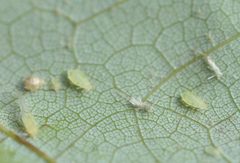
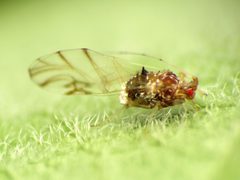
6Drepanaphis is a Nearctic of aphids comprising 18 , all native to North America. These insects are narrow oligophages primarily associated with maple trees (Acer spp.), with one species (D. monelli) recorded on buckeye. The genus is characterized by distinct abdominal , very long , and reduced leg chaetotaxy. Drepanaphis acerifoliae, the painted maple , has the broadest distribution and is the only species introduced to Europe. Unlike many aphids, Drepanaphis species do not form dense colonies and are not attended by ants.

Pronunciation
How to pronounce Drepanaphis: //ˈdrɛpəˌneɪfɪs//
These audio files are automatically generated. While they are not always 100% accurate, they are a good starting point.
Identification
Drepanaphis aphids can be distinguished from other by three key features: prominent abdominal , exceptionally long relative to body size, and reduced leg chaetotaxy (fewer setae on legs than typical aphids). The morph is the female. Sexual morphs ( females and males) have been documented for 15 ; oviparous females are while males are alate. Identification to species level requires examination of morphological details documented in taxonomic keys.
Images
Habitat
Associated with maple trees (Acer spp.) in natural and planted settings. In North America, distribution coincides with native eastern maple forests and western areas where maples have been planted as ornamentals. Suitable climatic conditions in Europe (where introduced) include Mediterranean regions, western Europe, and continental areas extending eastward through Russia to northern Kazakhstan.
Distribution
Native to North America; all 18 are Nearctic endemics except D. acerifoliae, which has been introduced to Europe. In North America, eastern align with natural plant ranges while western populations occur where hosts are cultivated. Climate models predict potential northward range expansion into eastern Canada and central/eastern European Russia under future warming scenarios.
Diet
Phloem-feeding on plant vascular tissues.
Host Associations
- Acer spp. - primary Maple trees; primary for most in
- Aesculus glabra - primary Buckeye; recorded specifically for D. monelli
Life Cycle
with both sexual and phases. The morph is the female, which reproduces by viviparous . occurs via females and alate males, which produce . Sexual morphs were documented for 15 for the first time in a 2024 taxonomic revision.
Behavior
Does not form dense colonies typical of many . Not attended by ants, lacking the mutualistic relationships common in other aphid .
Ecological Role
Phloem-feeding herbivores that produce honeydew, though not -tended. As maple , they contribute to nutrient cycling in forest and may serve as prey for and . D. acerifoliae is considered a pest of ornamental and crop maples.
Human Relevance
D. acerifoliae is recognized as a pest of maple trees in both North America and Europe, causing damage through direct feeding. The has been subject to taxonomic revision due to historical misidentifications in museum collections. Climate change modeling for D. acerifoliae predicts potential expansion of suitable , with implications for pest management in European forestry and horticulture.
Similar Taxa
- Other Drepanosiphinae generaShare characteristics but lack the combination of abdominal , very long , and reduced leg chaetotaxy diagnostic of Drepanaphis
- Ant-attended aphid genera (e.g., Aphis, Myzus)Drepanaphis is specifically distinguished by its lack of attendance and tendency not to form dense colonies
More Details
Taxonomic history
The was revised in 2024, increasing recognized from 16 to 18 with description of D. robinsoni and revalidation of D. nigricans and D. tissoti as distinct species. Previous studies focused primarily on of selected species without considering geographic distribution.
Research significance
The 2024 revision provided the first documentation of sexual morphs for 15 , correcting numerous historical misidentifications in museum collections through morphometric and PCA analyses.
Sources and further reading
- BugGuide
- GBIF taxonomy match
- iNaturalist taxon
- NCBI Taxonomy
- Catalogue of Life
- Bug Eric: Grand Finale
- Bug Eric: Last Night to Blacklight?
- Bug Eric: 2024
- Distribution ofDrepanaphis acerifoliae– aphid pest of Acer trees – faced with global climate change
- Taxonomic Revision of the Nearctic Genus Drepanaphis Del Guercio (Hemiptera, Aphididae: Drepanosiphinae).