
Myzus cerasi
(Fabricius, 1775)
black cherry aphid, cherry blackfly
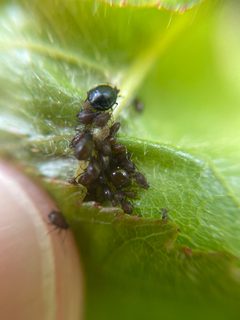
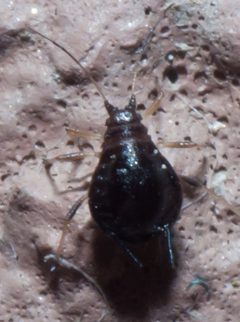
Myzus cerasi, commonly known as the black cherry or cherry blackfly, is a phloem-feeding aphid native to Europe that has become in distribution. The exhibits complex alternation between primary hosts (Prunus cerasus and Prunus avium) and secondary hosts (Galium and Veronica species). Two host-specific are recognized: M. c. cerasi on sour cherry and M. c. pruniavium on sweet cherry, distinguished by mitochondrial COI haplotypes and subtle morphological differences. The species is a significant agricultural pest of cherry orchards, forming dense colonies that cause leaf curling and damage to new growth.
Pronunciation
How to pronounce Myzus cerasi: /ˈmaɪ.zəs ˈkɛr.ə.siː/
These audio files are automatically generated. While they are not always 100% accurate, they are a good starting point.
Identification
Distinguished from other Myzus by the combination of shiny black body, entirely black siphunculi and cauda, and yellow-and-black legs and . The two M. c. cerasi and M. c. pruniavium cannot be reliably separated by single morphological characters but require multivariate discriminant analysis of morphometric data or COI haplotype analysis; a three-character linear discriminant function achieves >92% correct identification.
Images
Habitat
Found in cherry orchards and areas with wild Prunus . Colonies develop on growing top shoots of plants. Secondary host occur on herbaceous plants in late summer.
Distribution
originally from Europe, now distributed across Europe, parts of Asia, and introduced to North America (including Canada). Present in Belgium, Azores (Flores, Terceira), and widely across European cherry-growing regions.
Seasonality
densities positively correlated with temperature increases between seasons. In temperate regions, hatch in spring; parthenogenetic occur through summer; sexual forms and egg-laying return in autumn. Can persist on clematis through late autumn and potentially winter in mild conditions.
Diet
Phloem-feeding . Primary : Prunus cerasus (sour cherry) and Prunus avium (sweet cherry). Secondary hosts: Galium (including G. mollugo, hedge bedstraw) and Veronica species.
Host Associations
- Prunus cerasus - primary of M. c. cerasi
- Prunus avium - primary of M. c. pruniavium
- Galium mollugo - secondary Hedge bedstraw; summer in North America and Europe
- Galium aparine - secondary Cleavers; laboratory
- Barbarea verna - secondary Land cress; requires prior to cleavers
- Veronica species - secondary Secondary
Life Cycle
Heteroecious (-alternating) . Overwinters as on primary host (Prunus). In spring, eggs hatch and fundatrices initiate colonies on new growth. Multiple parthenogenetic produced through summer. In late summer, winged forms migrate to secondary hosts (Galium, Veronica) where additional parthenogenetic generations occur. In autumn, winged sexual forms return to primary host; males and females mate and females deposit eggs. Temperature significantly affects development rate and .
Behavior
Forms large, dense colonies on growing shoots that cause leaf curling. Exhibits extensive transcriptional plasticity when switching between plants, with differential regulation of detoxification and redox reaction genes. Sequential host observed: cannot survive on Land cress unless first adapted to cleavers. Winged forms produced in response to crowding and seasonal cues.
Ecological Role
Herbivorous pest of cherry . Honeydew production supports growth and attracts tending ants, yellowjackets, and other sugar-feeding insects. Serves as prey for predatory insects including lady beetles and .
Human Relevance
Major economic pest of sour and sweet cherry orchards worldwide. Dense colonies damage new growth and reduce fruit production. Subject to including using and (Bacillus thuringiensis strains have shown efficacy in laboratory and field studies). breeding programs explore natural deterrents based on profile differences between cherry .
Similar Taxa
- Myzus persicaeGreen peach aphid; differs in range ( vs. oligophagous), coloration (usually green or pinkish, not shiny black), and lack of host-specific structure
- Brachycaudus prunicolaFormerly confused with M. cerasi; distinguished by taxonomic revision and morphological differences, though both feed on Prunus
- Myzus variansPeach-clematis ; differs in primary (peach) and secondary host (clematis), and geographic distribution
Sources and further reading
- BugGuide
- Wikipedia
- GBIF taxonomy match
- iNaturalist taxon
- NCBI Taxonomy
- Catalogue of Life
- I am an Entomologist | Beetles In The Bush
- Holiday meals served by an alien plant and its cosmopolitan guest: Peach-clematis aphid, Myzus varians — Bug of the Week
- Nuptial Gifts and Other Romantic Gestures of the Bug World
- Sweet Taste Inhibitor Curbs Aphid Feeding, but Also Plant Growth
- Got Aphids? Call in the Reinforcements With Banker Plants
- Management Prospects for Alfalfa Mosaic Virus in Chile Peppers
- THE SECONDARY HOST OF MYZUS CERASI
- Figure 1 from: Rakauskas R, Havelka J, Zaremba A, Bernotienė R (2014) Mitochondrial COI and morphological evidence for host specificity of the black cherry aphids Myzus cerasi (Fabricius, 1775) collected from different cherry tree species in Europe (Hemiptera, Aphididae). ZooKeys 388: 1-15. https://doi.org/10.3897/zookeys.388.7034
- Extensive transcriptional changes in the aphid species Myzus cerasi under different host environments associated with detoxification genes
- Figure 3 from: Rakauskas R, Havelka J, Zaremba A, Bernotienė R (2014) Mitochondrial COI and morphological evidence for host specificity of the black cherry aphids Myzus cerasi (Fabricius, 1775) collected from different cherry tree species in Europe (Hemiptera, Aphididae). ZooKeys 388: 1-15. https://doi.org/10.3897/zookeys.388.7034
- Seasonal population fluctuation and life history in different temperatures of Myzus cerasi (Hemiptera: Aphididae) on cherry trees: a field and laboratory study
- Mögliche Ursachen der Resistenz von Kirschen (Prunus spp.) gegen Myzus cerasi F. (Hom., Aphididae)
- Mitochondrial COI and morphological evidence for host specificity of the black cherry aphids Myzus cerasi (Fabricius, 1775) collected from different cherry tree species in Europe (Hemiptera, Aphididae)
- Figure 4 from: Rakauskas R, Havelka J, Zaremba A, Bernotienė R (2014) Mitochondrial COI and morphological evidence for host specificity of the black cherry aphids Myzus cerasi (Fabricius, 1775) collected from different cherry tree species in Europe (Hemiptera, Aphididae). ZooKeys 388: 1-15. https://doi.org/10.3897/zookeys.388.7034
- Evaluation of Bacterial Strains as a Sustainable Approach for Control of Myzus cerasi (F.) (Hemiptera: Aphididae) Under Laboratory and Field Conditions.