
Elasmostethus interstinctus
(Linnaeus, 1758)
Birch Shield Bug
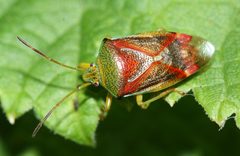
Elasmostethus interstinctus, commonly known as the birch shield bug, is a shield bug in the Acanthosomatidae with a Holarctic distribution across Europe, Northern Asia, and North America. measure 8–11.5 mm and display distinctive bright yellow-green and red coloration. The is , with adults in leaf litter and emerging in spring to reproduce on birch and other plants.
Pronunciation
How to pronounce Elasmostethus interstinctus: /ˌɛləsmoʊˈstiːθəs ˌɪntərˈstɪŋktəs/
These audio files are automatically generated. While they are not always 100% accurate, they are a good starting point.
Identification
Distinguished from the similar Hawthorn Shield Bug (Acanthosoma haemorrhoidale) by its smaller size, less elongate body shape, and larger lateral extensions of the pronotum. The intense red coloration on the , , and elytral apex is distinctive. The combination of yellow-green ground color with red markings and dense black punctures separates it from other Elasmostethus in regions where they co-occur.
Images
Appearance
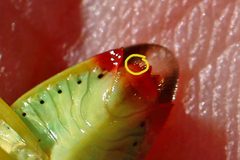
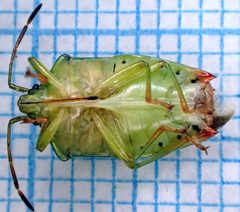
are 8–11.5 mm in length with a relatively flat, shield-shaped body. The entire upper surface is covered with dense black punctures. The side is bright yellow-green with prominent red markings: the pronotum is yellow-green, the scutellum is green with a red center, the and are intensely red, and the apex of the is bright red. The side and abdominal margins are yellow. Legs are yellow-green.
Habitat
Primarily inhabits sunny areas with mixed birch woodlands, deciduous trees, and shrubs. Associated with birch-dominated but has been recorded in various wooded environments supporting its plants.
Distribution
Holarctic distribution: widely distributed across Europe, Northern Asia (excluding China), and North America. Present in Japan where studies have been conducted.
Seasonality
overwinter and emerge in spring to mate. are laid from early June to mid-August. The new is complete by August. Adults are present year-round but active occurs during summer months.
Diet
Nymphs and feed on plant sap. Primary is birch (Betula ). Nymphs have also been recorded on aspen and hazel. Additional host plants include juniper, oak (Quercus), holly (Ilex), Vaccinium, alder (Alnus), beech (Fagus), and poplar (Populus).
Host Associations
- Betula - primary Main plant; laid on leaves and catkins, nymphs feed in
- Populus tremula - secondary aspen
- Corylus - secondary hazel
- Juniperus - occasional juniper
- Quercus - occasional oak
- Ilex - occasional holly
- Vaccinium - occasional
- Alnus - occasional alder
- Fagus - occasional beech
- Populus - occasional poplar
Life Cycle
with . Adults emerge from leaf litter in spring and mate. are laid from early June to mid-August on upper leaf surfaces and catkins of plants. Nymphs feed gregariously. The new completes development by August. No maternal care of eggs has been observed.
Behavior
Nymphs feed in on plants. overwinter in leaf litter. Excretes defensive secretions when disturbed, a trait common in shield bugs. Reproductive allocation varies temporally: females produce larger clutches with smaller early in the season, shifting to smaller clutches with larger, higher-quality eggs later in the season to maximize offspring survival before .
Ecological Role
Herbivore feeding on woody plants; nymphs are gregarious feeders on birch and other deciduous trees and shrubs. Serves as prey for various ; defensive secretions suggest pressure.
Human Relevance
Minor economic significance; feeding on birch and other trees may cause localized damage but is not considered a major pest. Sometimes encountered in gardens and woodlands. Subject of ecological research on reproductive allocation strategies.
Similar Taxa
- Acanthosoma haemorrhoidaleHawthorn Shield Bug is larger, more elongate, and has smaller lateral extensions of the pronotum; both share yellow-green and red coloration but differ in body proportions
More Details
Reproductive Biology
Lifetime correlates positively with female body size: larger females produce more and live longer than small females. Egg size does not vary with female size. Offspring survival to adulthood increases with egg weight. This favors larger eggs in later clutches, as nymphs from these eggs have less time to accumulate resources before .
Life History Research
Studies in Japan found no significant interspecific differences in clutch size among Elasmostethus , but significant differences in size, egg developmental periods, and female size. E. interstinctus is asocial with no maternal care of eggs, contrasting with subsocial species in the same .