
Elasmostethus
Fieber, 1860
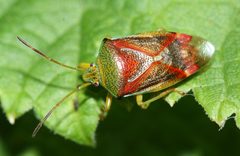
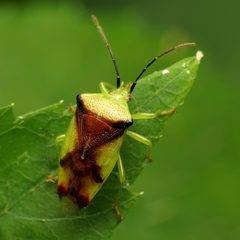
Birch shieldbug
Species Guides
3- Elasmostethus atricornis(Hercules club stink bug)
- Elasmostethus cruciatus(red-cross shield bug)
- Elasmostethus interstinctus(Birch Shield Bug)
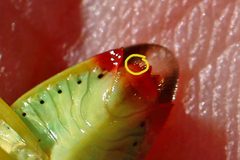
Elasmostethus is a of shield bugs in the Acanthosomatidae, comprising approximately 15 described distributed across the Holarctic region. The genus is notable for exhibiting asocial —specifically, the absence of maternal care of —contrasting with subsocial species found elsewhere in the family. Species within this genus show significant interspecific variation in traits including egg size, developmental periods, and female body size, though clutch size remains relatively consistent across species.
Pronunciation
How to pronounce Elasmostethus: //ɨˌlæzməˈstiːθəs//
These audio files are automatically generated. While they are not always 100% accurate, they are a good starting point.
Images
Distribution
Holarctic distribution with records from Europe (Denmark, Norway, Sweden), North America (Vermont, United States), and Japan. Individual have more restricted ranges; for example, E. interstinctus (birch shieldbug) is widespread in Europe.
Life Cycle
occurs before . In E. interstinctus, nymphs from later-laid have reduced time to gather resources before overwintering. Egg developmental periods vary among . No maternal care of eggs is exhibited by any species in the .
Behavior
Asocial with no maternal care of , distinguishing the from subsocial Acanthosomatidae that guard eggs. Females allocate reproductive resources differently across the reproductive period: relatively more to offspring number early in life, more to offspring quality (larger eggs) later in life.
More Details
Reproductive allocation patterns
In E. interstinctus, size increases over the reproductive period—eggs are smaller at the beginning and middle than at the end. Clutch mass and egg number per clutch decrease in laying sequence, with first clutches substantially larger than subsequent ones. Lifetime correlates positively with female size, though egg size does not vary with female size. Offspring survival to adulthood increases with egg weight.
Interspecific life history variation
Among six Japanese studied (E. amabilis, E. brevis, E. humeralis, E. interstinctus, E. kerzhneri, and E. nubilus), significant differences were found in size/weight, egg developmental periods, and female size. Only clutch size showed no significant interspecific variation.
Sources and further reading
- BugGuide
- Wikipedia
- GBIF taxonomy match
- iNaturalist taxon
- NCBI Taxonomy
- Catalogue of Life
- Interspecific variation in life history traits of Elasmostethus (Hemiptera: Acanthosomatidae)
- Temporal variation in reproductive allocation in a shield bug Elasmostethus interstinctus
- Interspecific variation in life history traits of Elasmostethus (Hemiptera: Acanthosomatidae)—ERRATUM