
Xanthochilus saturnius
(Rossi, 1790)
Mediterranean seed bug
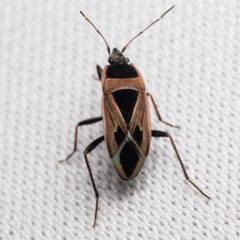
Xanthochilus saturnius, commonly known as the Mediterranean , is a small true in the Rhyparochromidae. It measures 6–8 mm and displays distinctive black-on-tan coloration. The is native to southern Europe and the Mediterranean region, with established in North America. It feeds primarily on seeds of Lamiaceae and Scrophulariaceae plants.
Pronunciation
How to pronounce Xanthochilus saturnius: /zænˈθɒkɪləs sæˈtɜːrniəs/
These audio files are automatically generated. While they are not always 100% accurate, they are a good starting point.
Identification
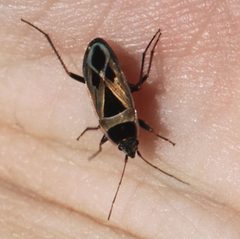
Distinguished from similar Rhyparochromidae by the specific pattern of black-on-tan markings: black and scutellum, pronotum with large black band plus stippled brown band, brown with two black spots, and large black mark on the . The Xanthochilus is sometimes treated as a subgenus of Rhyparochromus, requiring attention to current taxonomic usage in regional keys.
Images
Appearance
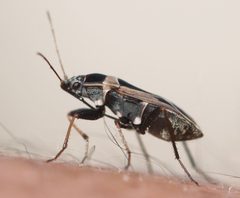
Small true measuring 6–8 mm in length. and scutellum are black. Pronotum has a large black band and a band of stippled brown. are brown with two black spots. of the forewing has a large black mark. Overall coloration is black-on-tan.
Habitat
Associated with plants in the Lamiaceae and Scrophulariaceae, particularly Stachys and Verbascum lychnitis. Found in areas where these plants grow and produce seeds.
Distribution
Native to southern Europe (Bosnia and Herzegovina, Bulgaria, Croatia, France, Greece, Italy, North Macedonia, Portugal, Slovenia, Spain, European Turkey, South European Russia) and the broader Mediterranean region including North Africa (Algeria, Egypt, Morocco, Tunisia), the Caucasus, and the Middle East (Israel, Syria, Turkey). Introduced and established in the : Greenland, Canada, USA, and northern Mexico.
Seasonality
overwinter in gregarious clusters and emerge in spring (April–May). New adults appear by July. Active period spans spring through summer with adults resuming activity the following year.
Diet
Feeding is specialized on seeds. and larvae feed together on the same plants and on fallen seeds. Primary plants are Stachys and other Lamiaceae, plus Scrophulariaceae (specifically Verbascum lychnitis).
Host Associations
- Stachys - primary Main , multiple used
- Verbascum lychnitis - primary Specific Scrophulariaceae
- Lamiaceae - -level association beyond Stachys
- Scrophulariaceae - -level association
Life Cycle
occurs as in gregarious clusters. from overwintering sites in April–May. Oviposition and larval development through spring and early summer. New adults produced by July, which will overwinter.
Behavior
form gregarious clusters for . Adults and larvae feed gregariously on the same plants. Both life stages feed on seeds both on the plant and on the ground as fallen seeds.
Ecological Role
Seed specializing on herbaceous plants in Lamiaceae and Scrophulariaceae. Gregarious feeding may influence local seed availability for plants. Serves as prey for .
Human Relevance
No documented agricultural or economic significance. Occasionally observed in gardens and natural areas. Introduced in North America represent a non-native whose ecological impacts have not been extensively studied.
Similar Taxa
- Rhyparochromus vulgarisSimilar size and ; distinguished by different color pattern on pronotum and , lacks the specific two-spot pattern on elytra and large mark of X. saturnius
- Other RhyparochromidaeMany share general brown-and-black coloration; precise spot patterns and banding on pronotum and are diagnostic for X. saturnius
More Details
Taxonomic Note
Xanthochilus is sometimes treated as a subgenus of Rhyparochromus rather than a full . Under this classification, the is rendered as Rhyparochromus saturnius or Rhyparochromus (Xanthochilus) saturnius. Current sources (GBIF, Catalogue of Life) accept Xanthochilus as a valid genus.
Range Expansion
The has established breeding in North America (Canada, USA, northern Mexico, Greenland), representing a successful transatlantic introduction from its native Mediterranean range.