
Oxycarenus lavaterae
(Fabricius, 1787)
lime seed bug
Oxycarenus lavaterae, commonly known as the lime , is a small true native to the Mediterranean Basin that has undergone rapid northward and eastward expansion across Europe since the 1970s, with a marked acceleration beginning in 2017. measure 4.2–5.6 mm and display distinctive red, black, and white coloration. The feeds on seeds of plants in the Malvaceae and has become a notable pest of urban linden plantings in newly colonized regions.
Pronunciation
How to pronounce Oxycarenus lavaterae: /ˌɒksɪˈkɛərənəs ləˈvætəriː/
These audio files are automatically generated. While they are not always 100% accurate, they are a good starting point.
Identification
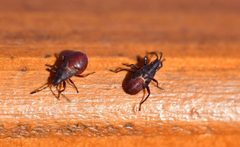
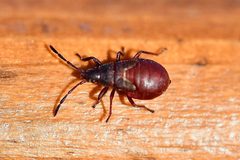
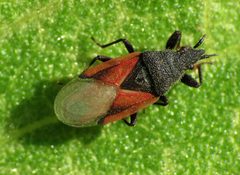
are distinguished by their striking color pattern: black , prothorax, scutellum, and ; brick-red upper with blackish connexivum; and transparent, colorless forewings reaching or slightly exceeding the abdomen tip. Nymphs have black heads, red abdomens, and completely black wing pads. Females (4.5–5.6 mm) are larger than males (3.7–5.2 mm), with statistically significant in body length, width, and length.
Images
Habitat
Primarily associated with urban and suburban environments, particularly single-row plantings of Tilia cordata (small-leaved lime) and other Tilia . In warmer native regions, found on Malvaceae including Lavatera, Althea, Hibiscus, and Malva. occur on tree trunks and branches, predominantly on linden but occasionally on Populus, Platanus, and Aesculus hippocastanum.
Distribution
Native to the Mediterranean Basin including North Africa. Since the 1970s, expanded northward into Benelux, Central Europe, and Eastern Europe. Rapid expansion phase documented from 2017 onward, with swift northward and eastward spread across Europe. Established in Ukraine (including Donetsk and Transcarpathia), with optimal predicted in Ukrainian regions. Records from Latvia indicate minimal invasion potential there.
Seasonality
Two in typical conditions. Active from August through November in northern expansion zones, with mass forming by September–October at the end of the vegetation season. Overwinters as in colder regions.
Diet
Feeds on seeds of plants in the Malvaceae, specifically Lavatera, Althea, Hibiscus, and Malva.
Life Cycle
Hemimetabolous development with two per year under favorable conditions. Overwinters as in on tree trunks and branches. Nymphs observed from August through November in expansion zones, with all developmental stages present simultaneously during this period.
Behavior
Forms dense on trees, with colonies reaching 500–3,000 individuals per tree by autumn. Exhibits basking to elevate body temperature using downward shortwave radiation, which mitigates cold stress and enhances survival in northern regions. This thermoregulatory behavior has been identified as a key factor enabling range expansion into cooler climates.
Ecological Role
pest in expanded range, particularly impacting urban linden plantings. Considered a pest requiring monitoring in countries where it has established. No significant documented role as or prey species in available literature.
Human Relevance
Recognized as an pest in multiple European countries. Causes concern for urban forestry due to heavy of ornamental linden trees. Subject of citizen science monitoring efforts and predictive modeling for pest management.
Sources and further reading
- BugGuide
- Wikipedia
- GBIF taxonomy match
- iNaturalist taxon
- NCBI Taxonomy
- Catalogue of Life
- Meloidae Holdings | Entomology Research Museum
- The Brightening Sky and the Bug's Advance: Unraveling the Drivers of Oxycarenus lavaterae Range Expansion
- The Brightening Sky and the Bug’s Advance: Unraveling the Drivers of Oxycarenus lavaterae Range Expansion
- <i>Oxycarenus lavaterae</i> (Fabricius, 1787) (Hemiptera: Heteroptera: Lygaeidae) – a new invasive species in the fauna of Donetsk: distribution, abundance, and morphometric characteristics