
Belonochilus numenius
(Say, 1831)
Sycamore Seed Bug, American Sycamore Seed Bug
Belonochilus numenius is a in the Lygaeidae, native to North America and in Europe since 2008. The completes its entire on seed balls of Platanus species. It has spread rapidly across Europe through plant trade and wind , reaching 17 countries including a widespread distribution in North Macedonia by 2019. High densities can cause nuisance in urban areas, though it is not considered harmful to trees.
Pronunciation
How to pronounce Belonochilus numenius: /bɛləˈnɒkɪləs nuːˈmiːniəs/
These audio files are automatically generated. While they are not always 100% accurate, they are a good starting point.
Identification
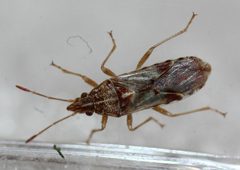
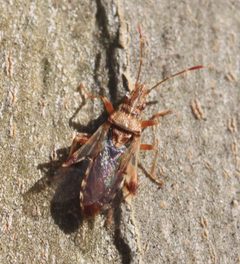
Distinguished from other European Lygaeidae by its elongate body and long slender rostrum. Confirmed by presence on Platanus seed balls and specific external morphological characteristics. The only in the Belonochilus, eliminating congeneric confusion in Europe.
Images
Appearance
Distinctive elongate body form with a long, slender rostrum characteristic of the . Specific external characteristics enable identification from similar lygaeid .
Habitat
Urban, peri-urban, and natural environments where plane trees (Platanus ) occur. Found on seed balls of trees. Documented at altitudes up to 964 meters above sea level in North Macedonia.
Distribution
Native to North America: USA, Mexico, and Canada (Ontario, British Columbia). in Europe: first recorded 2008 in Spain and France, subsequently reported from Italy, Monaco, Austria, Czech Republic, Slovakia, Serbia, Switzerland, Hungary, Germany, Bulgaria, Portugal (Madeira), Slovenia, Bosnia and Herzegovina, Albania, Greece, and Croatia. In North Macedonia: widespread across 29 cities and towns, 3 peri-urban areas, and 1 natural ; first recorded July 2019 in Skopje.
Seasonality
Active during summer months; and nymphs present on seed balls in July. Specific varies by region.
Diet
Feeds on seed balls of Platanus . Additional plants reported in North American literature include Ambrosia trifida, Celtis occidentalis, and Salix species, though European appear restricted to Platanus.
Host Associations
- Platanus x acerifolia - primary London plane; most common urban in Europe
- Platanus orientalis - primary Oriental plane; natural and planted
- Platanus occidentalis - primary American sycamore; native North American
Life Cycle
Completes entire on seed balls of Platanus . Both nymph and stages occur on seed balls simultaneously. Specific developmental duration and stage not documented in available sources.
Behavior
Aggregates in large numbers on seed balls, with up to 13 individuals observed per seed ball. Disperses through and wind. Spreads rapidly via passive transport in plant trade. High lead to mass that enter houses, balconies, and restaurants, causing public nuisance.
Ecological Role
in Europe. Not considered a threat to health of Platanus trees. Functions as urban pest and public nuisance due to at high densities. Not listed as pest by EPPO.
Human Relevance
Declared urban pest and public nuisance in Spain due to high disturbing citizens. Not a pest. Spread facilitated by horticultural trade of plane trees. No reported economic damage to trees.
Similar Taxa
- Other Orsillinae seed bugsBelonochilus numenius distinguished by elongate body, long slender rostrum, and exclusive association with Platanus seed balls; other Orsillinae typically feed on different plants
More Details
Invasion history
First European record in 2008; rapid spread to 17 countries within 11 years. North Macedonia likely established shortly after 2012 based on widespread 2019 distribution, but overlooked until formal survey.
Population density
Numerous individuals can occur per seed ball; study observed up to 13 individuals on single seed ball.