
Lygaeus truculentus
Stål, 1862
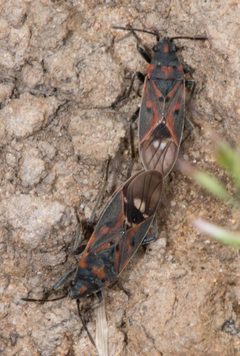
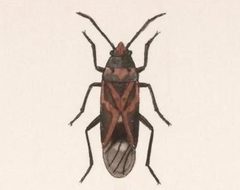
Lygaeus truculentus is a in the Lygaeidae, first described by Stål in 1862. Records indicate a distribution spanning from western North America through Central America to northern South America, with confirmed presence in California, USA. The species belongs to a containing several milkweed-associated , though specific ecological relationships for this particular species remain poorly documented.
Pronunciation
How to pronounce Lygaeus truculentus: /lɪˈdʒiːəs tɹʊˈkʌlɛntəs/
These audio files are automatically generated. While they are not always 100% accurate, they are a good starting point.
Images
Distribution
Documented from California, USA; also recorded from Guatemala, Mexico, Panama, and Venezuela. Distribution spans Middle America, North America, and South America.
More Details
Taxonomic note
Lygaeus truculentus is one of approximately 100 in the Lygaeus. The genus includes several well-studied North American species such as L. kalmii (small milkweed ) and L. turcicus (false milkweed bug), which have been extensively researched for their chemical and mimicry relationships. However, L. truculentus has received minimal specific study and its remains largely inferred from genus-level characteristics rather than direct observation.
Sources and further reading
- BugGuide
- Wikipedia
- GBIF taxonomy match
- iNaturalist taxon
- Catalogue of Life
- A Unique Connection and a Living Legacy | Bug Squad
- Bugs in orange and black: A spooky Halloween trick or treat for predators - Small and large milkweed bugs, 'Lygaeus kalmii' and 'Oncopeltus fasciatus' — Bug of the Week
- Bugs in orange and black: A spooky Halloween trick for predators, Small and large milkweed bugs, Lygaeus kalmii and Oncopeltus fasciatus — Bug of the Week
- Bug Eric: Small Milkweed Bug
- Bug Eric: Beetles from Bones
- Botanizing at Creve Coeur Lake | Beetles In The Bush