
Aradinae
Genus Guides
2Aradinae is a of flat bugs within the Aradidae, comprising at least 90 described . The subfamily is represented by the Aradus, which contains the majority of its diversity. Members are small, dorsoventrally flattened insects associated with decaying wood and fungal . They are part of the true order Hemiptera, characterized by .
Pronunciation
How to pronounce Aradinae: /ˌærəˈdaɪniː/
These audio files are automatically generated. While they are not always 100% accurate, they are a good starting point.
Identification
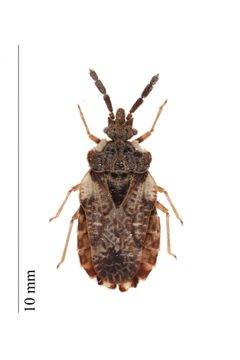
Aradinae can be distinguished from other aradid by the combination of a broadly oval body form, reticulate or areolate surface sculpturing on the pronotum and , and the structure of the and . Within Aradidae, Aradinae is the largest subfamily and contains the Aradus, which can be recognized by the presence of distinct areolation on the surface. -level identification requires examination of male genitalia and detailed surface sculpturing patterns. They may be confused with other flat bugs ( Aradidae) in the subfamilies Aneurinae or Calisiinae, which generally differ in body shape and degree of flattening.
Images
Appearance
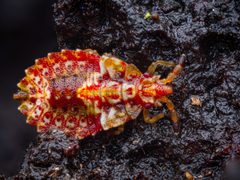
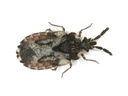
Members of Aradinae are dorsoventrally flattened with broadly oval to elongated bodies. The pronotum and forewings () often display intricate reticulate or areolate surface sculpturing. are and typically four-segmented. Body coloration ranges from brown to black, often with mottled or variegated patterns that provide camouflage against bark and wood substrates. The scutellum is usually triangular and may be large relative to body size. Legs are relatively short and adapted for clinging to rough surfaces.
Habitat
in Aradinae are primarily associated with dead and decaying wood, particularly hardwood logs and stumps. They inhabit spaces under bark, within decaying heartwood, and in fungal fruiting bodies. Moisture levels are critical; they require humid microhabitats found in mature forests and woodland . Some species show specificity to particular tree species or stages of wood decay.
Distribution
Aradinae has a distribution with documented across North America, Europe, Asia, and other temperate and tropical regions. The Aradus is particularly diverse in the Holarctic region. Specific distribution patterns vary by species, with some showing broad ranges and others restricted to particular forest types or geographic areas.
Seasonality
Activity patterns vary by and latitude. In temperate regions, are most commonly encountered from spring through autumn when they emerge to mate and disperse. typically occurs as adults under bark or in protected woody substrates. Some species may be active year-round in suitable microhabitats in milder climates.
Diet
Feeding habits center on fungal and spores, with some possibly consuming decaying plant material and associated microorganisms. They use their to extract nutrients from fungal substrates within decaying wood.
Life Cycle
Development includes , nymphal, and stages. Eggs are deposited in crevices of bark or within decaying wood. Nymphs undergo five instars, progressively resembling adults in form. Development is closely tied to the persistence of suitable fungal resources in decaying wood. time varies; some may require one to two years to complete development depending on environmental conditions.
Behavior
Aradinae are cryptic, remaining concealed under bark or within wood during daylight. They are slow-moving and rely on camouflage and flattening to avoid detection. When disturbed, they may remain motionless or move deeper into substrate crevices. occur primarily in , often triggered by drying or resource depletion.
Ecological Role
As fungivores, members of Aradinae contribute to nutrient cycling in forest by processing fungal in decaying wood. They serve as prey for various forest-dwelling including birds, spiders, and other arthropods. Their presence indicates mature forest conditions with substantial dead wood resources.
Human Relevance
Aradinae has minimal direct economic impact. The is occasionally encountered by entomologists, forest ecologists, and naturalists during surveys of saproxylic (dead wood dependent) insect . Some may be used as indicators of old-growth forest conditions or continuity in conservation assessments. They are not known to be pests of timber or structures.
Similar Taxa
- AneurinaeAnother of Aradidae; generally more elongate and slender with reduced surface sculpturing compared to Aradinae.
- CalisiinaeAradid with more pronounced lateral expansions of the pronotum and different wing venation patterns.
- TermitaphididaeFormerly considered a separate , now often placed within Aradidae; highly modified myrmecophilous or termitophilous with reduced and appendages, easily distinguished from free-living Aradinae.
More Details
Taxonomic Notes
The Aradus contains the vast majority of placed in Aradinae. The classification within Aradidae has undergone revision, with some authors recognizing additional subfamilies or treating certain groups as tribes. The precise boundaries of Aradinae relative to other aradid lineages remain under study.
Research Needs
Many within Aradinae are poorly known biologically, with limited information on specificity, fungal associations, and geographic distribution. Molecular phylogenetic studies may clarify relationships within the and inform species boundaries.