
Aradus
Fabricius, 1803
flat bugs
Species Guides
78Aradus is a of flat bugs ( Aradidae) containing approximately 200 or more distributed worldwide, with highest diversity in the Holarctic region. These insects are strongly associated with forest , particularly dead and decaying wood where they feed on fungi. Several species exhibit pyrophilous , colonizing burned forests to exploit fungi that grow on charred wood. The genus has a documented fossil record extending back to the Eocene, with 14 species described from Baltic amber inclusions.

Pronunciation
How to pronounce Aradus: /ˈærədəs/
These audio files are automatically generated. While they are not always 100% accurate, they are a good starting point.
Identification
Aradus are distinguished from other flat bug primarily by genitalic and structural characters that require microscopic examination. The genus-level identification relies on features of the male and female genitalia, abdominal sternite structure, and antennal segmentation. Species identification is challenging and typically requires examination of or detailed comparative studies; few new species have been discovered in North America in recent decades, suggesting regional faunas are relatively well documented.
Images
Appearance
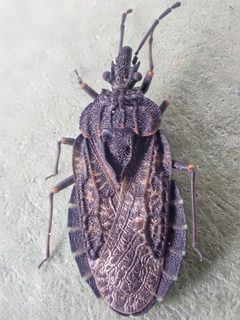
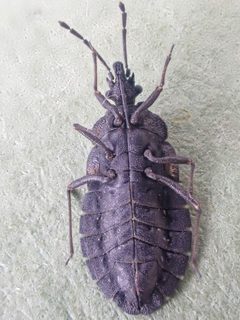
Members of Aradus are dorsoventrally flattened true bugs with broad, oval to elongate bodies. The body shape is highly adapted for living in confined spaces under bark. vary considerably in size; for example, the fossil species Aradus macrosomus is described as unusually large for the . The flattened is characteristic of the Aradidae and distinguishes these insects from most other heteropteran .
Habitat
Aradus inhabit forest environments, with strong association to dead and decaying wood. They are found on and under the bark of dead trees, where they exploit fungal resources. Some species are specifically adapted to burned , occurring in forests after wildfires where they feed on fungi colonizing charred wood. The association with dead wood explains their frequent preservation in amber deposits.
Distribution
Worldwide distribution, with primary concentration in the Holarctic region. Documented from North America (including Canada and the United States), Europe (including Germany, Austria, Czech Republic, Bulgaria, Finland), and Asia (China, Russia, Southeast Asia). The has been recorded from Baltic amber (Eocene, ~45 million years ago), indicating a long evolutionary history in northern temperate regions.
Seasonality
Activity patterns vary by and region. Aradus bimaculatus has been collected from late February through late March in Bulgaria, suggesting early spring activity for at least some species. Most species are likely active during the warmer months when fungal growth on dead wood is abundant.
Diet
Fungivorous. Aradus feed on fungi, particularly those growing on dead wood. Some species specialize on fungi colonizing burned conifers, such as Aradus laeviusculus on burned conifers and Aradus gracilis on burned South Florida slash pine (Pinus elliottii var. densa).
Host Associations
- Fungi - food sourcePrimary diet; feed on fungi growing on dead and burned wood
- Pinus sylvestris - Aradus cinnamomeus associated with Scots pine bark in Finland
- Pinus elliottii var. densa - Aradus gracilis occurs on burned South Florida slash pine
- Betula - Aradus betulae associated with birch in Europe and Russia
Behavior
Several exhibit pyrophilous , actively colonizing burned forest to exploit post-fire fungal . Aradus cinnamomeus show distinctive spatial patterns in relation to industrial pollution gradients, with highest densities occurring 1–2 km from pollution sources. The flattened body form allows movement in tight spaces under bark. Some species may be phoretically associated with other organisms; for example, a tarsonemid mite has been documented under the hemielytra of Aradus betulae.
Ecological Role
Decomposers and fungal grazers in forest . Contribute to nutrient cycling in dead wood . Pyrophilous serve as early colonizers of post-fire environments, facilitating ecosystem recovery. Aradus serbicus is considered a primeval forest relict species in Central Europe, indicating its value as a bioindicator of structurally complex, undisturbed forest habitats. Aradus cinnamomeus has been used as a bioindicator of forest stress related to atmospheric pollution.
Human Relevance
Aradus cinnamomeus (pine bark ) is recognized as a forest pest in some contexts, with high densities causing injury to Scots pine that manifests as reduced growth. The has been studied as a bioindicator of industrial air pollution effects on forest . Some species are becoming increasingly rare due to forest loss and fragmentation.
Similar Taxa
- Other Aradidae generaFlat bugs in other share the dorsoventrally flattened body form and bark-dwelling habits; distinguished by genitalic and structural characters
More Details
Fossil Record
Fourteen of Aradus have been described from Baltic amber inclusions dating to the Eocene (~45 million years ago). The excellent preservation of these fossils is attributed to the ecological association of extant species with tree resin sources (dead trees). Aradus macrosomus, described from Baltic amber, is notably large-bodied compared to .
Conservation Concern
North American Aradus are considered vulnerable to extinction due to forest disappearance and restriction. Aradus serbicus is regarded as an ancient, primeval forest relict in Central Europe, highlighting sensitivity to habitat degradation.
Pollution Response
Aradus cinnamomeus show positive correlations with heavy metal deposition (Cd, Cu, Ni, Pb, Zn), suggesting physiological changes in trees from atmospheric pollution may benefit this and other sap-feeding insects.
Sources and further reading
- BugGuide
- Wikipedia
- GBIF taxonomy match
- iNaturalist taxon
- NCBI Taxonomy
- Catalogue of Life
- Aradus macrosomus Archives - Entomology Today
- Uncategorized | Blog - Part 23
- Pensoft blog - Part 128
- New species from the past | Blog
- 45-million-year-old Flat Bug Found in Baltic Amber
- Erstnachweis von Aradus aterrimus Fieber, 1864 für Österreich (Heteroptera, Aradidae)
- First records of Heterotoma merioptera (Scopoli, 1763) and Aradus serbicus (Horváth, 1888) (Heteroptera: Miridae et Aradidae) from Germany
- NEW SPECIES AND NEW RECORDS OF ARADUS (ARADIDAE, HEMIPTERA)
- Distribution of the flat bug Aradus obtectus (Hemiptera: Heteroptera: Aradidae) and the bark-gnawing beetle Peltis grossa (Coleoptera: Trogossitidae) in the Czech Republic and their first records in the White Carpathians
- A new genus and species of Tarsonemidae (Acari: Heterostigmata) associated with Aradus betulae (Heteroptera: Aradidae) from European Russia
- Industrial air pollution and the pine bark bug, Aradus cinnamomeus Panz. (Het., Aradidae)
- An unexpected guest in the winter: first record of Aradus bimaculatus Reuter, 1872 (Hemiptera: Aradidae) for the Balkan fauna
- New records, a synonymy and a new species of Aradus Fabricius, 1803 (Hemiptera: Heteroptera: Aradidae) from China