
Ambrysus pudicus
Stål, 1862
creeping water bug, saucer bug
Ambrysus pudicus is a of creeping water bug ( Naucoridae) described by Carl Stål in 1862. It belongs to the diverse New World Ambrysus, which is distributed from northern North America to Argentina with highest diversity in Mexico. Like other members of its family, it is an aquatic inhabiting running streams. The specific epithet 'pudicus' (Latin for 'bashful' or 'modest') is shared with the unrelated pitcher plant Nepenthes pudica, which was named for its hidden underground traps.
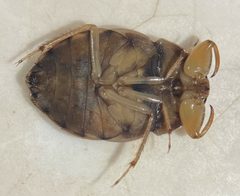
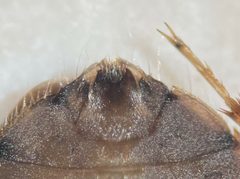
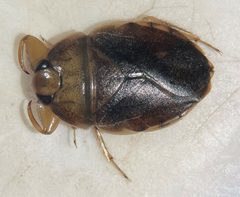
Pronunciation
How to pronounce Ambrysus pudicus: /ˈæmbɹɪsəs ˈpjuːdɪkəs/
These audio files are automatically generated. While they are not always 100% accurate, they are a good starting point.
Images
Habitat
Running streams; aquatic in both nymphal and stages. Based on -level , likely clings to rocks and gravel in turbulent water using powerful claws.
Distribution
Middle America and North America (records from GBIF). Exact range within these regions not specified in available sources.
Similar Taxa
- Ambrysus cayoCongeneric described in 2014 from Belize, also inhabits running streams in western Belize; differs in specific wing markings (orange marks on dark wings) and size (~9.76 mm length vs. unknown for A. pudicus)
- Other Ambrysus species contains numerous across the Americas; identification to species level requires examination of specific morphological characters not detailed in available sources for A. pudicus
More Details
Taxonomic note
Catalogue of Life lists 'Ambrysus pudicus pudicus' as an accepted , but GBIF and NCBI recognize A. pudicus as a . The subspecific designation may reflect taxonomic uncertainty or geographic variation not well resolved in current literature.
Etymology
The specific epithet 'pudicus' derives from Latin, meaning 'bashful,' 'modest,' or 'chaste.' This same epithet was later used for Nepenthes pudica, a Bornean pitcher plant named for its concealed underground pitchers.