
Hebrus
Curtis, 1831
velvet water bugs
Species Guides
3- Hebrus buenoi(Bueno's velvet water bug)
- Hebrus burmeisteri(velvet water bug)
- Hebrus consolidus
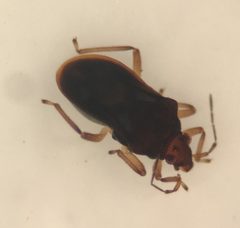
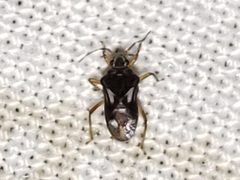
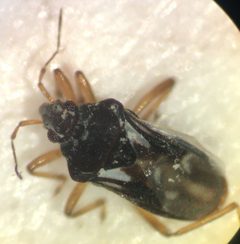
Hebrus is a of velvet water bugs in the Hebridae, comprising at least 160 described worldwide. Members are small (1.3–3.7 mm), plump-bodied, brownish to black insects densely covered with setae. They inhabit humid terrestrial and marginal freshwater across diverse geographic regions including the West-Palaearctic, Argentina, and Morocco. The genus includes both and species, with some flightless forms known from restricted localities such as the Apuan Alps of Italy.
Pronunciation
How to pronounce Hebrus: /ˈhɛb.rus/
These audio files are automatically generated. While they are not always 100% accurate, they are a good starting point.
Identification
Distinguished from other Hebridae by combination of small size, plump body form, and dense setation. forms (e.g., Hebrus atlas, H. franzi) can be recognized by reduced wing development. -level identification requires examination of male genitalia and other detailed morphological characters; regional keys are available for Argentina and the West-Palaearctic.
Images
Appearance
Small (1.3–3.7 mm), plump-bodied insects with brownish to black coloration. Body densely covered with setae, giving a velvety appearance. Some (short-winged) or flightless.
Habitat
Humid terrestrial environments and marginal freshwater . Includes moist soil, wet moss, and edges of ponds, streams, and other water bodies. Some occupy specific microhabitats such as karstic areas in montane regions.
Distribution
Worldwide distribution with records from the West-Palaearctic (including Morocco, Bulgaria, Greece, Israel, Cyprus, Iran, Oman, Lithuania, Romania), Argentina (central region, La Pampa province), and Italy (Apuan Alps, Tuscany). GBIF records indicate presence in Colombia, Denmark, Norway, and Sweden.
Diet
Predatory
Ecological Role
Predatory insects in humid terrestrial and freshwater margin . Potential indicators of moisture conditions and water quality in some regions.
Human Relevance
Subject of taxonomic research due to high and cryptic . Some of conservation interest due to restricted distributions and specificity (e.g., flightless species in isolated montane habitats). Proposed as potential indicators for environmental monitoring in wetland and riparian habitats.
Similar Taxa
- LipogomphusAnother in Hebridae; distinguished by different body proportions and genitalia structure
- MerragataCo-occurring Hebridae ; differs in body shape and setation patterns
More Details
Taxonomic Complexity
The Hebrus has been divided into subgenera including Hebrus s. str. and Hebrusella based on morphological characters. boundaries can be difficult to establish due to subtle morphological differences and geographic variation.
Conservation Concerns
Flightless such as Hebrus franzi and H. atlas may be vulnerable to loss due to restricted ranges and specific microhabitat requirements in montane or karstic environments.
Sources and further reading
- BugGuide
- Wikipedia
- GBIF taxonomy match
- iNaturalist taxon
- NCBI Taxonomy
- Catalogue of Life
- A new species of Hebrus (Hemiptera: Heteroptera: Hebridae) from Argentina
- Resource potential and planning for exploration of the Hebrus Valles, Mars
- The Fluvial and Volcanic History of Hebrus Valles and Hephaestus Fossae on Mars
- The “Italian hebrid”, Hebrus franzi (Wagner, 1957): disentangling a half-century dilemma (Hemiptera: Heteroptera: Gerromorpha)
- Review of West-Palaearctic Hebridae with description of a new species and redescription of Hebrus fulvinervis (Hemiptera: Heteroptera)
- Water-driven Accessible Potential Karstic Caves in Hebrus Valles, Mars: Implications for Subsurface Habitability