
Phymata albopicta
Handlirsch, 1897
jagged ambush bug
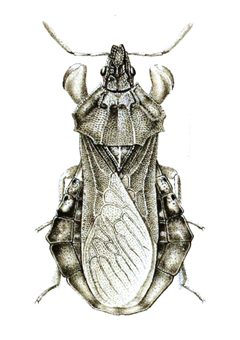
Phymata albopicta is a of jagged ambush bug in the Reduviidae. Like other members of the Phymata, it is a sit-and-wait that hunts on flowers, using forelegs to seize prey. The species has been documented in North America and Middle America. It exhibits , with females being larger and capable of capturing larger prey items.
Pronunciation
How to pronounce Phymata albopicta: /faɪˈmeɪtə ælboʊˈpɪktə/
These audio files are automatically generated. While they are not always 100% accurate, they are a good starting point.
Identification
Distinguished from other Phymata by specific pattern of markings (the species epithet "albopicta" refers to white markings). The angular, jagged body shape separates Phymata from other reduviid . Females are notably larger and more robust than males. Presence on flowers in late summer and fall, often with prey in grasp or nearby, is characteristic of the genus.
Images
Habitat
Found in flowering vegetation, particularly composite flowers such as goldenrods (Solidago spp.) and sunflowers (Helianthus spp.). Occurs in diverse settings including prairies, meadows, forest edges, and disturbed with sandy soils. The occupies the floral microhabitat, perching on buds and blossoms to ambush visiting insects.
Distribution
Recorded from North America and Middle America. Specific distribution within these regions requires further documentation; GBIF records indicate presence in both regions.
Seasonality
Active during late summer and fall, coinciding with peak flowering of goldenrods and other composite flowers. Activity period aligns with abundance of prey.
Diet
that feeds on other insects. Prey includes bees, , flies, , and butterflies that visit flowers for nectar. The injects paralytic saliva containing digestive that liquefy prey tissues, which are then consumed.
Host Associations
- Solidago spp. - /prey sitegoldenrods; primary hunting ground
- Helianthus spp. - /prey sitesunflowers; abundant hunting site with extrafloral attracting diverse insects
Behavior
Sit-and-wait that remains motionless on flowers until prey approaches within striking distance. Seizes prey with forelegs in a rapid, forceful attack that produces an audible snap. Males frequently ride piggy-back on females, sharing in the female's larger kills. This may or may not lead to mating. The grip is sufficiently powerful that the can sometimes subdue prey using only one foreleg.
Ecological Role
in floral , regulating of and other flower-visiting insects. Contributes to top-down control of insect associated with composite flowers. Serves as prey for larger predators and for kleptoparasitic Machiidae flies that feed on prey remains.
Human Relevance
Beneficial insect in natural and agricultural settings due to on other insects. Poses no direct threat to humans; unlike some reduviids, ambush bugs do not bite defensively. May be observed by naturalists and photographers on late-season flowers.
Similar Taxa
- Phymata fasciataSimilar jagged ambush bug and ; distinguished by specific marking patterns and geographic distribution
- Phymata pennsylvanicaOverlapping range and use; requires examination of pronotal and abdominal markings for separation
- Phymata erosaConvergent body form and hunting strategy; -level identification relies on detailed examination of color pattern and pronotal structure
More Details
Taxonomic history
Ambush bugs were formerly placed in their own Phymatidae but are now classified as the Phymatinae within Reduviidae (assassin bugs).
Kleptoparasitism
Tiny Machiidae flies frequently congregate at ambush bug kills to feed on oozing fluids from prey, acting as kleptoparasites.
Hunting failure
When attacking large or powerful prey, ambush bugs may be physically removed from their perch and forced to abandon the prey and relocate.