
Sirthenea
Spinola, 1837
corsairs
Species Guides
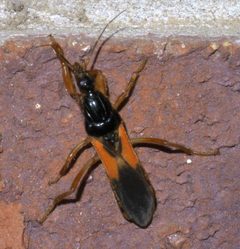
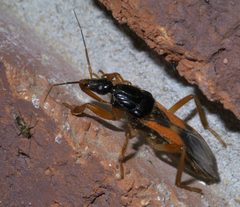
1Sirthenea is a of assassin bugs (Reduviidae: Peiratinae) comprising at least 40 described . It is distinguished from other Peiratinae by an elongated body, triangular anteocular , shortened rounded , and the absence of fossa spongiosa on medial tibiae (except in S. laevicollis). The genus has a nearly global distribution spanning Afrotropical, Oriental, Palearctic, Oceanian, and Australian regions, with representatives occurring on almost all continents. Sirthenea species are ground-dwelling, that prey on other insects.
Pronunciation
How to pronounce Sirthenea: /sɪrˈθiːniə/
These audio files are automatically generated. While they are not always 100% accurate, they are a good starting point.
Identification
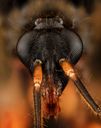
Distinguished from other Peiratinae by combination of: elongated body form; triangular anteocular region; shortened, rounded ; and absence of fossa spongiosa (a specialized glandular structure) on medial tibiae, except in S. laevicollis where it is present. Identification to level requires examination of genitalic structures and other morphological characters detailed in regional keys.
Images
Habitat
Ground-dwelling in areas with tree vegetation, primarily tropical and subtropical moist broadleaf forests and temperate broadleaf/mixed forest biomes. Most favorable occur roughly between 43°N and 42°S parallel, with strong association to tropical and temperate climates characterized by adequate precipitation.
Distribution
distribution across Afrotropical, Oriental, Palearctic, Oceanian, and Australian zoogeographical regions; occurs on almost all continents. Documented from 521 occurrence localities including Africa and Madagascar (61), North America (61), Central America (23), South America (206), and Asia/Oceania/Australia (170). North and Central American concentrated in Gulf Coastal Plain from Florida Panhandle through southern United States to northeastern and eastern Mexico.
Diet
Non-specialized preying on other insects.
Behavior
ground-dwelling . Active as during nighttime hours.
Ecological Role
insect in ground-dwelling .
Similar Taxa
- Other Peiratinae generaSirthenea differs in body proportions, shape, femoral structure, and absence of fossa spongiosa on tibiae (except S. laevicollis)
More Details
Evolutionary history
Phylogenetic analyses indicate the began diverging in the Late Cretaceous into two major clades, with subsequent branching in the Paleocene. The fossula spongiosa and its evolutionary development appear to be key morphological characters associated with occupation.
Taxonomic complexity
Multiple synonymies have been proposed, including S. flavipes encompassing several previously described species (S. clavata, S. bharati, S. koreana, S. melanota, S. nigripes). Some , particularly S. flavipes, show incipient speciation patterns with distinct color forms separated by geographic barriers.
Sources and further reading
- BugGuide
- Wikipedia
- GBIF taxonomy match
- iNaturalist taxon
- NCBI Taxonomy
- Catalogue of Life
- A taxonomic revision of the genus Sirthenea (Hemiptera: Heteroptera: Reduviidae) of the Old World
- Are we witnessing speciation? A case study of the species Sirthenea flavipes (Stål, 1855) (Heteroptera: Reduviidae)
- Distribution Pattern and Climate Preferences of the Representatives of the Cosmopolitan Genus Sirthenea Spinola, 1840 (Heteroptera: Reduviidae: Peiratinae)
- Genetic data of museum specimens allow for inferring evolutionary history of the cosmopolitan genus Sirthenea (Heteroptera: Reduviidae)
- Figure 4: Behavioural responses of the frog Pelophylax nigromaculatus to the bombardier beetle Pheropsophus occipitalis jessoensis and the assassin bug Sirthenea flavipes .