
Barce fraterna
(Say, 1832)
Species Guides
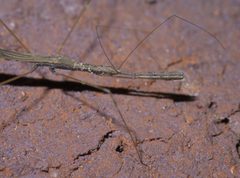
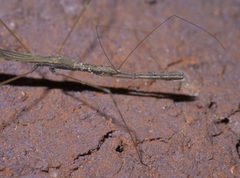
1Barce fraterna is a thread-legged bug ( Emesinae) in the assassin bug Reduviidae. The has a broad distribution spanning the Caribbean, Central America, North America, and South America, including the Galápagos Islands. Three are recognized: B. f. annulipes, B. f. banksii, and the nominate B. f. fraterna. Like other emesines, it possesses the characteristic elongated, slender legs adapted for on other arthropods.
Pronunciation
How to pronounce Barce fraterna: //ˈbɑːrsə frəˈtɜːrnə//
These audio files are automatically generated. While they are not always 100% accurate, they are a good starting point.
Identification
As a member of the Emesinae (thread-legged bugs), Barce fraterna can be distinguished from other reduviid by its extremely slender, elongate legs—particularly the hind legs, which are often modified for grasping prey. Within the Barce, -level identification requires examination of male genitalia and subtle differences in leg spination and body proportions. The three differ in details of coloration and leg annulation: B. f. annulipes (described 1867) shows distinct leg banding, while B. f. banksii (described 1910) and the nominate subspecies differ in geographic origin and minor morphological traits.
Images
Distribution
Widespread across the Neotropical and Nearctic regions: Caribbean islands, Central America, North America, and South America. Documented from the Galápagos Islands. The show geographic partitioning: B. f. fraterna in eastern North America, B. f. annulipes in the Caribbean and Central America, and B. f. banksii in the southern United States and Mexico.
Similar Taxa
- Other Emesinae genera (e.g., Emesaya, Stenolemus)Share the thread-legged but differ in structure, leg proportions, and male genitalia; Barce typically have a more robust pronotum and distinct tibial spination patterns.
- Reduviidae: other subfamilies (e.g., Reduviinae, SalyaLack the extreme leg elongation characteristic of Emesinae; most have forelegs rather than modified hind legs for prey capture.
More Details
Subspecies taxonomy
The three were described over a 78-year period (1832–1910), reflecting gradual refinement of geographic variation in this widespread . No recent taxonomic revision has comprehensively evaluated their validity using molecular data.
Collection records
GBIF and iNaturalist document 84+ observations, with records concentrated in the southern United States, Mexico, and Caribbean islands, though the full range extends throughout the Neotropics.