
Tytthus
Fieber, 1864
Species Guides
8Tytthus is a of predatory plant bugs (Miridae) specialized in feeding on planthopper . range from approximately 1 mm to 3.6 mm in length. The genus has undergone extensive taxonomic revision, having been placed in multiple tribes before current placement in Semiini. Several species have been used successfully in programs against agricultural pests.
Pronunciation
How to pronounce Tytthus: /ˈtɪθəs/
These audio files are automatically generated. While they are not always 100% accurate, they are a good starting point.
Identification
Tytthus resembles the Cyrtorhinus, with which it was formerly synonymized. It can be distinguished by pretarsal structures and male genitalia, including a U-shaped endosoma and fine setae on the parempodia. The small size of male genitalia relative to body and the presence of a yellow dot on the inner margin are additional distinguishing features.
Images
Appearance
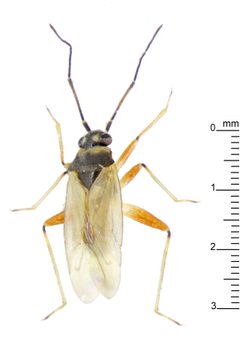
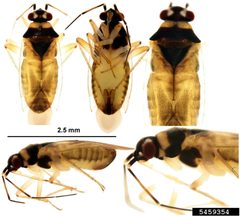
have shiny, broad, globose with dark brown to black coloration on the head, pronotum, and scutellum. The possess a distinctive yellow dot on the inside edge. are pale and translucent. Legs and are slender. Males of T. wheeleri are just over 1 mm long; T. mundulus reaches approximately 3.6 mm.
Habitat
Agricultural and natural supporting of delphacid planthoppers. Documented from rice fields, sugarcane fields, and associated grassland . Laboratory studies indicate successful development on rice plants (Oryza sativa) when planthopper are available.
Distribution
Holarctic distribution throughout the Northern Hemisphere, with extensions into tropical regions. Documented from China, Thailand, Iraq, Australia, South America, and the Indo-Pacific. Specific records from Denmark, Norway, and Sweden. Type originally described from Estonia.
Diet
Specialized of planthopper , primarily in Delphacidae. Documented prey includes Sogatella furcifera (white-backed planthopper), Nilaparvata lugens (), Laodelphax striatellus (small brown planthopper), and Perkinsiella saccharicida. Minimum prey of 4 eggs per day required for stability; marked increase in survival and at 10 eggs per day.
Host Associations
- Oryza sativa - plant of preyRice variety Taichung Native 1 (TN1) used in laboratory studies
- Sogatella furcifera - preyWhite-backed planthopper; primary prey in Chinese rice agroecosystems
- Nilaparvata lugens - prey
- Laodelphax striatellus - preySmall
- Perkinsiella saccharicida - preySugarcane planthopper; target of program in Hawaii
Life Cycle
stage followed by five nymphal instars, then . Egg developmental period approximately 7 days. Pre-oviposition period measured from female adult to first egg-laying. Development, survival, and rates depend strongly on prey egg .
Behavior
Nymph rate increases with age, following Holling Type II (decelerating increase to plateau). Sex-specific predation strategies: females consume more than males, but males exhibit higher search (a/Th ratio). At high prey (30 eggs/day), females reproduce earlier and male lifespan shortens. Has been observed engaging in reciprocal intraguild predation with Cyrtorhinus lividipennis. More effective than C. lividipennis at controlling at high temperatures (38°C).
Ecological Role
natural enemy of planthopper pests in agricultural . Reduces pest below , decreasing reliance on chemical . Contributes to in rice and sugarcane agroecosystems.
Human Relevance
Important agent. Tytthus mundulus was imported from Queensland, Australia to Hawaii in early 20th century to control Perkinsiella saccharicida on sugarcane, representing an early success story in . T. chinensis is utilized for control of rice planthoppers in Asian agroecosystems. Subject of monitoring protocols for programs.
Similar Taxa
- CyrtorhinusFormerly considered synonymous with Tytthus; distinguished by pretarsal structures, male genitalia , and molecular evidence. Tytthus has been placed outside Leucophoropterini while Cyrtorhinus remains within that tribe.
- KaroocapsusPreviously grouped with Tytthus in Leucophoropterini based on morphological similarities including U-shaped endosoma; now separated based on 2011 molecular and morphological evidence showing Tytthus belongs outside this tribe.
More Details
Taxonomic History
Established by Fieber in 1864. Synonymized with Cyrtorhinus by Reuter; resurrected by Carvalho and Southwood in 1955 based on pretarsal and genital characters. Type originally designated as Tytthus geminus (Flor, 1860), but corrected in 1992 to Tytthus pubescens (Knight, 1931) due to prior use of the name geminus by Thomas Say in 1832. Tribe placement changed multiple times: Phylini (1958), Leucophoropterini (1974), returned to Phylini (1999), and finally Semiini (2013).
Biological Control Applications
Successful establishment of T. mundulus in Hawaii for sugarcane pest control demonstrated the 's potential for . Current research focuses on optimizing in rice systems, with studies indicating that prey management and temperature considerations are critical for effective pest suppression.
Sources and further reading
- BugGuide
- Wikipedia
- GBIF taxonomy match
- iNaturalist taxon
- NCBI Taxonomy
- Catalogue of Life
- Functional and Numerical Responses of Tytthus chinensis (Hemiptera: Miridae) to Sogatella furcifera (Hemiptera: Delphacidae)
- Sampling Distributions and Sequential Sampling Plans for Perkinsiella saccharicida Kirkaldy (Hemiptera: Delphacidae) and Tytthus spp. (Hemiptera: Miridae) on Sugarcane