
Psallus
Fieber, 1858
Species Guides
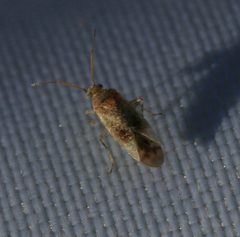
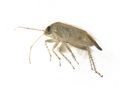
3Psallus is a of plant bugs in the Miridae, Phylinae, comprising over 160 described . The genus is predominantly Palearctic in distribution, with some species demonstrating Holarctic ranges and several having been introduced to the Nearctic region. Species are generally small, often measuring under 4 mm, with many exhibiting reddish or orange coloration. plant associations have been documented for several species, primarily with woody plants including oaks (Quercus), willows (Salix), and birch (Betula).

Pronunciation
How to pronounce Psallus: /ˈpsal.lus/
These audio files are automatically generated. While they are not always 100% accurate, they are a good starting point.
Identification
-level identification within Psallus requires examination of male genitalia, particularly the structure of the vesica (membranous part of the ) and left clasper. Many species share similar habitus, especially the uniformly orange or reddish coloration characteristic of numerous Palearctic . Small body size alone is insufficient for species identification; for example, P. thomashenryi at 2.3 mm is distinguished from similar-sized by unique vesica with three fingerlike, apically bent blades. External morphology often shows minimal interspecific variation, necessitating dissection for reliable determination.
Images
Habitat
occur in diverse environments ranging from Mediterranean shrublands to northern zones. Documented include shrubs and trees at village margins near watercourses, oak-dominated slopes, and willow-associated wetlands. Several species are arboreal, inhabiting the or foliage of broad-leaved trees.
Distribution
Predominantly Palearctic, with the highest diversity in Europe and western Asia. Turkey harbors 36 confirmed with 33% (12 species), highlighting the importance of Anatolia and the Syro-anatolian-transcaucasian region. Some species are genuinely Holarctic: P. aethiops and P. betuleti occur across northern Eurasia and North America. Multiple European species have been introduced to Canada, including P. roseus (British Columbia, 1970), P. lepidus and P. flavellus (Nova Scotia, 1976), likely via nursery stock. P. falleni occurs naturally across the Holarctic.
Host Associations
- Quercus cerris - plantdocumented for P. lucanicus
- Quercus pubescens - plantdocumented for P. lucanicus
- Quercus macrolepis - plantdocumented for P. lucanicus
- Salix - plantinferred from P. salicicola epithet; requires confirmation
- Betula - plantimplied by P. betuleti association
Human Relevance
Several have been inadvertently introduced to North America via nursery stock, with established in Canada. P. seriatus, known as the cotton hopper, has been studied for its economic relationship with cotton, though detailed relations require further examination. The serves as a subject for studies on Palearctic-Holarctic faunal dynamics and patterns in Anatolia.
Similar Taxa
- Other Phylinae generaPsallus is distinguished within Phylini by combination of small size, reddish coloration, and specific male genitalia structures; precise boundaries with related require genitalic examination
- P. asthenicusP. thomashenryi is distinguished from this similar uniformly orange by extremely small size (2.3 mm) and distinct vesica with three apically bent blades versus different genitalic structure in P. asthenicus
Sources and further reading
- BugGuide
- Wikipedia
- GBIF taxonomy match
- iNaturalist taxon
- NCBI Taxonomy
- Catalogue of Life
- Psallus thomashenryi sp. n. and Psallus lucanicus from Turkey (Hemiptera, Heteroptera, Miridae)
- PSALLUS SALICICOLA, A NEW SPECIES, WITH ADDITIONAL RECORDS OF RECENTLY DISCOVERED PALEARCTIC PSALLUS FIEBER FROM CANADA (HETEROPTERA: MIRIDAE: PHYLINAE)
- The host relation of the cotton flea hopper (Psallus seriatus Reuter)
- FOUR EUROPEAN SPECIES OF PSALLUS FIEBER FOUND IN CANADA (HETEROPTERA: MIRIDAE)
- Taxonomy and distribution of Psallus betuleti (Fallén) and P. montanus Josifov stat. nov (Heteroptera, Miridae)
- On the Distribution and Host Plants of the Cotton Flea-Hopper (Psallus Seriatus Reuter) Hemiptera, Miridae