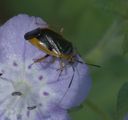
Metriorrhynchomiris dislocatus
(Say, 1832)
Wild Onion Mirid
Metriorrhynchomiris dislocatus is a mirid plant bug known for extreme color , with at least fifteen documented color forms. measure approximately 6.5 mm and are active primarily from April to July. The is associated with woodland in eastern North America, with documented associations to False Solomon's Seal and Wild Geranium.


Pronunciation
How to pronounce Metriorrhynchomiris dislocatus: /mɛtri.oˌrɪŋkoʊˈmaɪrɪs dɪsloʊˈkeɪtəs/
These audio files are automatically generated. While they are not always 100% accurate, they are a good starting point.
Identification
Distinguished from similar mirids by combination of: (1) larger than average size for (~6.5 mm), (2) extreme color making pattern-based identification unreliable, (3) association with specific plants in woodland , particularly False Solomon's Seal (Smilacina racemosa) and Wild Geranium (Geranium maculatum). Color pattern alone is insufficient for identification due to documented polymorphism. Specimens from Illinois, Pennsylvania, and Massachusetts have been confirmed through association with documented host plants and habitat.
Images
Appearance
measure approximately 6.5 mm, slightly larger than typical mirid plant bugs. Exhibits extreme color with at least fifteen documented color forms, ranging from red and orange to yellow, green, and brown patterns. No consistent geographic pattern to color variation. General body plan typical of Miridae: oval to elongate-oval body, with (forewings) partially leathery at base and membranous at tip.
Habitat
Primarily shady, moist woodland . Documented from forest understories and edges. In Illinois, found in Forest Preserve System areas. Associated with herbaceous layer vegetation in deciduous or mixed woodlands.
Distribution
Eastern North America, ranging from adjacent Canada west to Alberta and Colorado, south to Florida and Texas. Documented from: Massachusetts, Illinois, Indiana, Maine, Connecticut, Minnesota, New Jersey, New York, Pennsylvania, West Virginia, Wisconsin, Georgia, Quebec, Ontario, Alberta.
Seasonality
active primarily April through July, with timing varying by latitude. Records from Massachusetts in early June, Illinois in late June.
Diet
Phytophagous, feeding on plant sap. Demonstrably associated with False Solomon's Seal (Smilacina racemosa) and Wild Geranium (Geranium maculatum) as plants. Also observed as flower visitor, obtaining nectar from: Canadian Horseweed (Conyza canadensis), Philadelphia Fleabane (Erigeron philadelphicus), Smooth Oxeye (Heliopsis helianthoides), Canada Goldenrod (Solidago canadensis), Early Goldenrod (Solidago juncea), and male flowers of Revolute Meadowrue (Thalictrum revolutum).
Host Associations
- Smilacina racemosa - False Solomon's Seal; primary association
- Geranium maculatum - Wild Geranium; primary association
- Conyza canadensis - flower visitornectar source
- Erigeron philadelphicus - flower visitornectar source
- Heliopsis helianthoides - flower visitornectar source
- Solidago canadensis - flower visitornectar source
- Solidago juncea - flower visitornectar source
- Thalictrum revolutum - flower visitormale flowers, nectar source
- Lonicera canadensis - associatedAmerican Fly Honeysuckle; Quebec record, probably not
- Maianthemum stellatum - associatedStar-flowered Lily-of-the-Valley; Wisconsin record, probably not
- Poa pratensis - associatedKentucky Bluegrass; Pennsylvania record, probably not
- Sanicula marilandica - associatedMaryland Black Snakeroot; Kansas record, probably not
- Vitis sp. - associatedgrape; Ontario record, probably not
Behavior
Flower-visiting documented for nectar feeding. No other specific behaviors described in available sources.
Ecological Role
Herbivore feeding on woodland herbaceous plants. Acts as flower visitor, potentially contributing to pollination through nectar feeding. Part of mirid guild in eastern deciduous forest .
Human Relevance
Occasional garden visitor; one observer noted similar-appearing feeding on garden phlox, though effectiveness of organic (insecticidal soap) reported as limited. No significant economic impact documented.
Similar Taxa
- Other Metriorrhynchomiris speciesSame , require careful examination of genitalia or association for separation; color in M. dislocatus complicates visual identification
- General MiridaeColor pattern alone unreliable due to extreme ; size (~6.5 mm) and specific plant associations help distinguish
Misconceptions
Color pattern is not diagnostic for this ; the fifteen+ color forms led earlier to consider naming variants as , but Blatchley recognized this as rather than geographic variation.
More Details
Taxonomic history
Originally described as Capsus dislocatus by Say in 1832. Willis Stanley Blatchley (1859-1940) referred to such polymorphic true bugs as "spotted dogs" and resisted splitting color variants into .
Research gaps
plant records remain incomplete for many mirids; this has demonstrable hosts but many additional plant records lack confirmation of actual feeding versus incidental presence.