
Metriorrhynchomiris
Kirkaldy, 1904
plant bugs
Species Guides
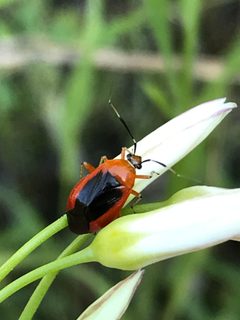
3Metriorrhynchomiris is a of plant bugs in the Miridae, containing at least three described . The genus is most well-documented through Metriorrhynchomiris dislocatus, a widespread North American species known for extreme color . Members are associated with woodland and diverse plant .


Pronunciation
How to pronounce Metriorrhynchomiris: /meˌtri.orɪŋˈkɑmɪrɪs/
These audio files are automatically generated. While they are not always 100% accurate, they are a good starting point.
Identification
The is distinguished by the remarkable color of M. dislocatus, with at least fifteen documented color forms that show no geographic pattern. measure approximately 6.5 mm, slightly larger than typical mirids. Accurate identification requires examination beyond color pattern due to this variability.
Images
Habitat
Shady, moist woodland . Associated with herbaceous vegetation including False Solomon's Seal (Maianthemum racemosum) and Wild Geranium (Geranium maculatum).
Distribution
Eastern North America west to Alberta and Colorado, south to Florida and Texas, and adjacent Canada.
Seasonality
active primarily April through July, with timing varying by latitude.
Diet
Phytophagous, feeding on plant sap. Associated with specific plants including False Solomon's Seal and Wild Geranium. Also observed as flower visitors obtaining nectar from various plants including Canadian Horseweed, Philadelphia Fleabane, Smooth Oxeye, Canada Goldenrod, and Early Goldenrod.
Host Associations
- Maianthemum racemosum - False Solomon's Seal, primary association
- Geranium maculatum - Wild Geranium, primary association
- Conyza canadensis - flower visitorCanadian Horseweed, nectar source
- Erigeron philadelphicus - flower visitorPhiladelphia Fleabane, nectar source
- Heliopsis helianthoides - flower visitorSmooth Oxeye, nectar source
- Solidago canadensis - flower visitorCanada Goldenrod, nectar source
- Solidago juncea - flower visitorEarly Goldenrod, nectar source
- Thalictrum revolutum - flower visitorRevolute Meadowrue, male flowers observed in Pennsylvania
- Lonicera canadensis - associatedAmerican Fly Honeysuckle, Quebec records
- Maianthemum stellatum - associatedStar-flowered Lily-of-the-Valley, Wisconsin records
- Poa pratensis - associatedKentucky Bluegrass, Pennsylvania records
- Sanicula marilandica - associatedMaryland Black Snakeroot, Kansas records
- Vitis - associatedgrape, Ontario records
Behavior
Flower-visiting documented, with observed obtaining nectar from multiple plant . plant fidelity demonstrated for key species.
Ecological Role
Herbivore in woodland . Flower-visiting suggests potential role in pollination, though this has not been quantified.
Similar Taxa
- Other MiridaeColor in M. dislocatus creates superficial similarity to many other mirid ; accurate identification requires careful examination beyond color pattern.
More Details
Color polymorphism
M. dislocatus exhibits extreme color with at least fifteen documented color forms, a phenomenon that led entomologist Willis Stanley Blatchley to term such 'spotted dogs.' Variation shows no correlation with geographic location.
Taxonomic history
established by Kirkaldy in 1904. Contains three described : M. dislocatus (Say, 1832), M. fallax (Reuter, 1909), and M. illini (Knight, 1942).