
Nogodinidae
Melichar, 1898
Nogodinid Planthoppers
Subfamily Guides
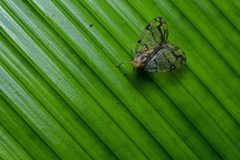
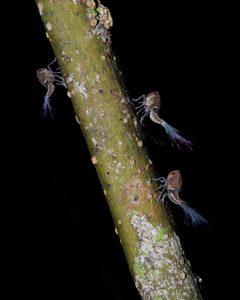
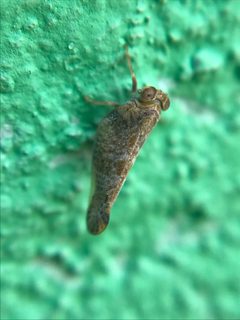
1is a of planthoppers within the superfamily Fulgoroidea. Members are distinguished by membranous wings with reticulate venation, a longer than wide, and arising well below the with a clubbed base and unsegmented . The family contains four extant (Bladininae, Gastriniinae, Colpopterinae, Nogodininae) and one fossil subfamily (†Ambitaktoinae). Taxonomic placement has been historically unstable, with some authors treating Nogodinidae as a subfamily of Issidae. Most are forest-dwelling and less than 2 cm in length.
Pronunciation
How to pronounce Nogodinidae: /nɔɡɒˈdɪnɪˌdiː/
These audio files are automatically generated. While they are not always 100% accurate, they are a good starting point.
Identification
Distinguished from similar Fulgoroid (Issidae, Tropiduchidae) by the combination of: longer than wide; reticulate wing venation; arising well below the with clubbed base and unsegmented ; lateral ocelli outside facial margins; and male genital style longer than broad. Hind leg (spined tibia, spine on second tarsal segment) provides additional diagnostic characters. Confusion with Issidae is common; molecular data (COI, 18S rRNA, 28S rRNA) may be required for definitive identification in some cases.
Images
Appearance
Small planthoppers, less than 2 cm in length. () longer than wide, with carinae (keels) on the margins. arise well below the , with base clubbed and unsegmented. Lateral ocelli positioned outside the margins of the face. Wings membranous with delicate, reticulate venation. Hind leg with spines toward the tip of the tibia; second tarsal segment bears an spine. Male genitalia with style longer than broad, a key diagnostic character for the .
Habitat
Predominantly forest . Many members of the Colpoptera and related are associated with palms. Specific microhabitats include lowland tropical rainforest and cloud forest. The shows affinity for woody vegetation, though detailed associations are known for relatively few species.
Distribution
Widespread in tropical and subtropical regions. Bladininae: Central and South America. Subfamily Gastriniinae: Brazil. Subfamily Colpopterinae: Central America, southern Africa, Jamaica, Rica. Subfamily Nogodininae: broader distribution including Africa, Asia, and Pacific islands. Vietnam records include Bach Ma National Park and Phong Dien District. Iran records include transfer of Iranissus ephedinus from Issidae to . Fossil known from mid-Cretaceous Myanmar, Eocene Baltic, Miocene Chiapas, and Miocene Dominican amber.
Host Associations
- palms - associated withMultiple Colpoptera collected during surveys of planthoppers on palms; specific palm species not always identified
- coconut palms (Cocos nucifera) - associated withColpoptera japortla collected during survey of phytoplasma on coconut palms in Jamaica
Ecological Role
Some surveyed as potential phytoplasma , though vector capability is stated as potential rather than confirmed. Role in processes not well documented; likely phloem feeders on woody plants.
Human Relevance
Economic importance primarily through potential as crop pests and . Colpoptera have been surveyed specifically as potential phytoplasma vectors affecting coconut palms. Planthoppers in related cause reduced crop yield through feeding, oviposition, and transmission; similar impacts may occur in but are not well documented. Taxonomic instability complicates pest management and identification.
Similar Taxa
- IssidaeHistorically confused with ; some authors treat Nogodinidae as of Issidae. Distinguished by male genitalia structure, ocellar position, and wing venation patterns.
- TropiduchidaeSimilar membranous wings and body form; distinguished by facial proportions, antennal placement, and hind leg spine arrangements.
More Details
Taxonomic instability
The has experienced significant taxonomic revision. Four (Paralusanda, Paramangola, Chondroptera, Neolollius) were transferred from Issidae to in 2017. Iranissus ephedinus was transferred from Issidae to Nogodinidae. These transfers reflect ongoing clarification of boundaries between Nogodinidae and Issidae.
Molecular systematics
Recent descriptions of new Colpoptera have included molecular data (COI, 18S rRNA, 28S rRNA genes) to support tribal placement. These data help resolve relationships within Colpopterini and confirm generic assignments where alone is ambiguous.
Fossil record
The fossil †Ambitaktoinae was erected in 2019. Additional fossil include the tribe Celinapterixini, based on an Argentinian fossil that could not be placed in extant tribes. Fossil are known from mid-Cretaceous Myanmar, Eocene Baltic, Miocene Chiapas, and Miocene Dominican amber.
Sources and further reading
- BugGuide
- Wikipedia
- GBIF taxonomy match
- iNaturalist taxon
- NCBI Taxonomy
- Catalogue of Life
- Uncategorized | Blog - Part 52
- A list of the planthoppers of Iran | Blog
- A new species of planthopper in the genus Colpoptera (Hemiptera:Fulgoroidea: Nogodinidae) from the Caribbean coast of Costa Rica
- On the taxonomic position of the genera Paralusanda Synave, Paramangola Synave, Chondroptera Bergroth, and Neolollius Muir (Hemiptera: Auchenorrhyncha: Fulgoroidea: Nogodinidae)
- A new species of planthopper in the genus Colpoptera (Hemiptera: Fulgoroidea: Nogodinidae) from the Northeastern coast of Jamaica
- Pisachini planthoppers of Vietnam: new records of Pisacha and a new Goniopsarites species from Central Vietnam (Hemiptera, Fulgoromorpha, Nogodinidae)
- New planthoppers in the genus Colpoptera (Hemiptera: Auchenorrhyncha: Fulgoroidea: Nogodinidae) from lowland tropical rainforest and cloud forest in Costa Rica