
Flatoidinae
Melichar, 1902
Genus Guides
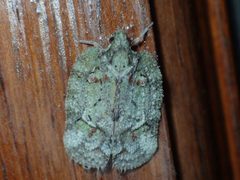
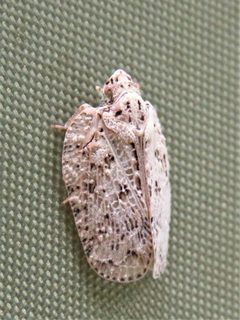
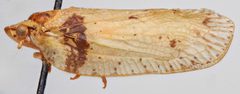
4Flatoidinae is a of planthoppers within the Flatidae, distinguished by their dorsoventrally flattened body form and wings held in a nearly horizontal position when at rest. Members of this subfamily are found primarily in tropical and subtropical regions, particularly in the Neotropics and West Indies. The subfamily was established by Melichar in 1902 and contains multiple including Petrusa and Ormenis. in this group are phytophagous and can achieve high densities on plants.
Pronunciation
How to pronounce Flatoidinae: /flæˈtoɪdɪniː/
These audio files are automatically generated. While they are not always 100% accurate, they are a good starting point.
Identification
Distinguished from Flatinae by the horizontal wing posture and flattened body form. The parallel cross- along the costal margin of the forewings separate Flatidae from the related Acanaloniidae, which have reticulate venation. -level identification requires examination of genitalia and detailed wing venation patterns.
Images
Habitat
Tropical and subtropical forests, coastal dune systems, and agricultural areas. Often associated with woody plants including seagrape, coffee, citrus, and various mangrove .
Distribution
Primarily distributed in the Neotropical region, with substantial diversity in the West Indies, Central America, and South America. Records exist from Puerto Rico, Argentina, and throughout the Caribbean basin.
Diet
Phloem-feeding on a broad range of woody plants. Documented hosts include seagrape (Coccoloba uvifera), coffee (Coffea arabica), coco-plum (Chrysobalanus icaco), jasmine (Jasminum spp.), and black mangrove (Avicennia germinans).
Host Associations
- Coccoloba uvifera - primary Documented for Petrusa epilepsis in Puerto Rico; can reach high densities on seagrape plants.
- Coffea arabica - pest Petrusa epilepsis has become a pest of coffee, causing damage through direct feeding and development on honeydew.
- Chrysobalanus icaco - Documented for Petrusa epilepsis.
- Jasminum spp. - Documented for Petrusa epilepsis.
- Avicennia germinans - Black mangrove documented as for Petrusa epilepsis; -planthopper associations have been studied on this host.
Life Cycle
Hemimetabolous development with , nymph, and stages. Nymphs are also flattened and cryptically colored. Specific details of egg and nymphal instars are not well documented in published literature.
Behavior
are relatively sedentary and can be approached closely; they have been observed to move slowly around stems when disturbed. High densities can occur, with adults forming on plant foliage. Like other flatids, they excrete honeydew that supports growth.
Ecological Role
Primary consumers as phloem-feeders. Honeydew production supports fungi and potentially mutualists. Some have pest status in agricultural systems.
Human Relevance
Some are agricultural pests. Petrusa epilepsis has established pest status on coffee and other crops in the West Indies, causing direct feeding damage and indirect damage through of honeydew-covered foliage. The represents a potential invasion risk to mainland tropical and subtropical America.
Similar Taxa
- FlatinaeSister within Flatidae; distinguished by tent-like wing posture held roof-like over the body and more cylindrical body form rather than the flattened, horizontal-winged condition of Flatoidinae.
- AcanaloniidaeRelated within Fulgoroidea; distinguished by reticulate forewing venation without the parallel cross- along the costal margin that characterize Flatidae including Flatoidinae.
More Details
Taxonomic history
The Flatoidinae was established by Melichar in 1902. Historical works such as Wolcott (1948) recognized the distinction between Flatoidinae and Flatinae based on wing posture and body form, noting that roughly half of Puerto Rican flatid belong to each subfamily.
Invasion potential
in this , particularly Petrusa epilepsis, are considered high-risk for introduction to tropical and subtropical mainland America. Many flatids are -plant , and the documented pest status of P. epilepsis on multiple crop and ornamental plants in the West Indies indicates significant potential for economic impact if established elsewhere.