
Tylopelta
Fowler, 1894
Species Guides
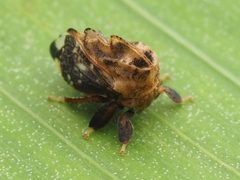
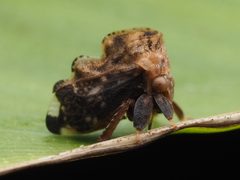
1Tylopelta is a of treehoppers in the Membracidae, established by Fowler in 1894. The genus contains at least four described distributed in the Americas. Treehoppers in this genus exhibit the characteristic enlarged pronotum typical of Membracidae, with species showing globular body forms and corrugated pronotal surfaces. One species, Tylopelta americana, occurs in eastern North America and has been noted for its elongate form compared to related Neotropical genera such as Bolbonota.
Pronunciation
How to pronounce Tylopelta: /ˌtaɪloʊˈpɛltə/
These audio files are automatically generated. While they are not always 100% accurate, they are a good starting point.
Identification
Tylopelta can be distinguished from similar by its globular to elongate body form with corrugated pronotal surface and lack of prominent pronotal horns or spines. In eastern North America, Tylopelta americana is recognized by its slightly more elongate form compared to the more globular Neotropical Bolbonota. -level identification requires examination of detailed morphological characters including pronotal shape and male genitalia. The genus belongs to the tribe Membracini, characterized by their particular pronotal modifications and New World distribution.
Images
Appearance
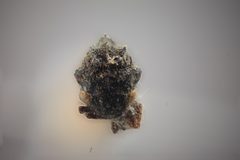
Members of Tylopelta possess the enlarged, often bizarrely modified pronotum characteristic of treehoppers (Membracidae). Tylopelta americana, the eastern North American representative, has a slightly more elongate body form compared to the globular shape seen in related Neotropical such as Bolbonota. The pronotum is corrugated in texture. are typically dark in coloration. The body form is heavy and compact, with the pronotum extending posteriorly over much of the .
Habitat
Specific associations are poorly documented for most Tylopelta . Treehoppers in the tribe Membracini are generally associated with woody and herbaceous plants. Tylopelta americana has been recorded from eastern North American deciduous forests. Related in the same tribe are found on low shrubs and various plants in forest and woodland environments.
Distribution
The has a New World distribution. Tylopelta americana occurs in eastern North America. Other in the genus have more southern distributions: Tylopelta gibbera ranges from Mexico through Central America and the Caribbean to South America; Tylopelta appendiculata and Tylopelta monstrosa are primarily Neotropical; Tylopelta obscura was described from material in South America.
Diet
Like all treehoppers, Tylopelta are phloem feeders, using their to extract sap from plants. Specific host plant associations have not been well documented for most species in this .
Life Cycle
Treehoppers typically undergo with , nymph, and stages. Nymphs of related Membracini show markedly different appearance from adults, with early instars often dark and later instars becoming mottled or streaked before adults revert to dark coloration. mutualism has been documented in related genera, where ants tend nymphs for honeydew.
Behavior
Treehoppers in this tribe often aggregate on plants. Related show association , with ants tending nymphs in exchange for honeydew. and nymphs position themselves along plant stems. When disturbed, they can move quickly to the opposite side of stems to avoid detection.
Ecological Role
As phloem feeders, Tylopelta function as herbivores in their . Their honeydew production supports mutualisms. They serve as prey for various including birds, spiders, and predatory insects. The nymphs in particular may form significant food sources for ant colonies.
Human Relevance
No direct economic or medical significance has been documented for Tylopelta . They are of interest to entomologists studying and evolution, particularly regarding pronotal diversification and mimicry complexes.
Similar Taxa
- BolbonotaBoth belong to tribe Membracini and share globular body form, corrugated pronotum, and dark coloration. Tylopelta americana is slightly more elongate than Bolbonota , which are strictly Neotropical.
- BolbonotoidesSimilar globular form and corrugated pronotum; distinguished by distribution (single Mexican ) and specific pronotal details.
More Details
Systematic position
Tylopelta is classified in the tribe Membracini, a group of New World treehoppers characterized by diverse pronotal modifications. The was established by Fowler in 1894.
Species diversity
At least four are currently recognized: Tylopelta americana (eastern North America), T. gibbera (widespread in Neotropics), T. appendiculata, T. monstrosa, and T. obscura (South America).