
Gargarini
Distant, 1908
Genus Guides
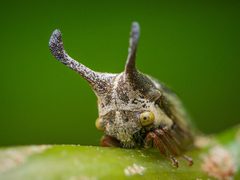
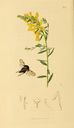
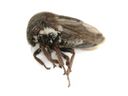
1Gargarini is a tribe of treehoppers ( Membracidae, Centrotinae) containing over 400 across 28 . First described by William Lucas Distant in 1908, it represents one of the most species-rich tribes within the primitive subfamily Centrotinae, which occurs in both Old and New Worlds. Members are characterized by highly diverse pronotal structures, including suprahumeral horns and pronotal processes that range from simple to complex morphologies. Molecular phylogenetic studies place Gargarini as sister to the tribes Leptocentrini, Hypsauchenini, Centrotini, and Leptobelini, with diversification estimated in the Late Cretaceous approximately 79.6 million years ago.
Pronunciation
How to pronounce Gargarini: //ɡarˈɡaːrɪni//
These audio files are automatically generated. While they are not always 100% accurate, they are a good starting point.
Identification
Gargarini can be distinguished from other Centrotinae tribes by specific pronotal configurations, particularly the presence of suprahumeral horns and pronotal processes in many derived . The tribe exhibits extensive morphological diversity in pronotal ornamentation, ranging from species lacking suprahumeral horns (ancestral condition) to those with elaborate horn-like projections. Unlike the more derived of Membracidae (Membracinae, Darninae, Smiliinae, Stegaspinae), which are restricted to the New World, Gargarini as part of Centrotinae occurs in both Old World and New World regions. The exposed scutellum, not covered by the expanded pronotum, is a subfamily-level character shared with other Centrotinae.
Images
Distribution
Gargarini has a broad geographic distribution spanning both Old World and New World regions, consistent with its placement in the primitive Centrotinae. Documented occurrences include South Africa (Umfilianus declivus, Oxyrhachis latipes, Stalobelus sp.) and Mexico (multiple ). The tribe's presence in both African and Neotropical regions reflects the ancestral distribution pattern of Centrotinae prior to the Tertiary isolation and subsequent New World radiation of other membracid subfamilies.
Similar Taxa
- LeptocentriniSister tribe to Gargarini within Centrotinae; distinguished by different pronotal and phylogenetic placement based on molecular data
- HypsaucheniniClosely related tribe within the Centrotinae clade containing Gargarini; differs in pronotal structure and distribution patterns
- CentrotiniRelated tribe within Centrotinae; Gargarini can be differentiated by specific pronotal horn configurations and mitochondrial characteristics
- LeptobeliniSister group to the clade containing Gargarini; morphological distinctions in pronotal processes separate these tribes
- BooceriniAnother tribe within Centrotinae; Gargarini differs in pronotal and phylogenetic position as revealed by mitogenomic analysis
More Details
Mitochondrial Genome Characteristics
Complete mitochondrial of Gargarini range from 15,253 to 15,812 and exhibit strong AT (75.8-78.5%). Six complete mitogenomes have been sequenced: Antialcidas floripennae, Centrotoscelus davidi, Kotogargara minuta, Machaerotypus stigmosus, Tricentrus fulgidus, and Tricentrus gammamaculatus.
Pronotal Evolution
Ancestral state reconstruction confirms absence of suprahumeral horns as the ancestral condition for Gargarini, with subsequent evolutionary transitions from simple to increasingly complex pronotal structures observed across the tribe.
Historical Collection Context
The Umfilianus (tribe Gargarini) was documented from South Africa in entomological collections, representing one of the few Old World records of this tribe in recent systematic surveys.