
Cloeon dipterum
(Linnaeus, 1761)
Pond Olive
Cloeon dipterum is a small with a Holarctic distribution, widespread across Europe, Asia, and North America. It is the most common mayfly in ponds of the British Isles, occurring in approximately 40% of all ponds and 70% in southern regions. The species is notable for being the only mayfly in Europe: females retain internally for 10–14 days after mating, and nymphs hatch immediately upon contact with water. Males possess distinctive turbinate — "turban-shaped" superposition eyes that aid in locating females during mating swarms. The species has been established as a laboratory model for studying insect evolution, development, and ecotoxicology.
Pronunciation
How to pronounce Cloeon dipterum: /ˈklo.e.on ˈdɪp.tɛ.rum/
These audio files are automatically generated. While they are not always 100% accurate, they are a good starting point.
Identification
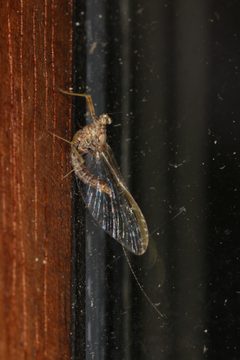
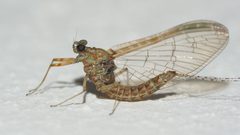
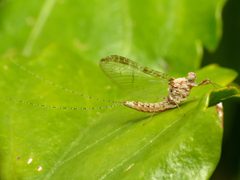
Distinguished from other mayflies by the presence of only one pair of functional wings (forewings), with hindwings or absent—reflected in the specific epithet "dipterum" (two wings). Males are readily identified by their unique turbinate , which appear as "turban-shaped" expansions of the . Females can be identified by their lateral-only apposition eyes and . In the British Isles, it is the most common pond-dwelling , often co-occurring with other lentic but separable by wing reduction and eye .
Images
Appearance
possess only a single pair of functional wings (forewings), with hindwings reduced to tiny structures or absent entirely. The exhibit striking : females have lateral apposition , while males have additional "turban-shaped" (turbinate) superposition eyes. Body size is small relative to other mayflies. Nymphs are aquatic with adaptations for surviving in lentic environments.
Habitat
Primarily inhabits standing freshwater, specifically ponds and lentic water bodies. Nymphs are adapted to survive in anoxic conditions, an essential for in ponds that freeze over and experience oxygen depletion. Laboratory studies indicate sensitivity to food availability and risk cues, with growth and development plasticity in response to environmental conditions.
Distribution
Holarctic distribution spanning Europe, Asia, and North America. In Europe, widespread across the continent including the British Isles, where it is the commonest pond . In North America, first recorded in Illinois in 1953 and Ohio in 1960, now known to have a wide distribution across the continent. Asian records include Korea. Previously reported from Madeira, but those are now recognized as a separate , Cloeon peregrinator.
Seasonality
occurs during warmer months; specific timing varies by region. In the British Isles, active during the typical season. Nymphs overwinter in ponds, surviving months of anoxic conditions under ice.
Life Cycle
: females retain fertilized internally for 10–14 days after mating, then deposit them into water where they hatch immediately upon contact. Nymphs develop underwater with hemimetabolous development; duration varies with food availability and environmental conditions. Nymphs can survive extended periods in anoxic conditions, an for winter survival in frozen ponds. lack functional mouthparts and do not feed; lifespan in captivity up to three weeks for females, though typical adult lifespan in nature is brief. Two occur in the adult stage: from nymphal as subimago (dun), followed by a second molt to (spinner).
Behavior
Males form mating swarms and use their turbinate superposition to locate isolated females. Nymphs exhibit behavioral hydrodynamics involving swimming and positioning in water. Growth rate, number of , and development time are phenotypically plastic in response to food availability and risk cues from such as larvae.
Ecological Role
Member of the EPT (Ephemeroptera, Plecoptera, Trichoptera), a recognized indicator group for assessing water quality and environmental health. High sensitivity to pollutants, particularly , makes it valuable for ecological risk assessment. Serves as prey for aquatic including larvae. Contributes to nutrient cycling in pond through its role in detrital as nymphs.
Human Relevance
Established as a laboratory model organism for studying insect evolution, development, and . Widely used in ecotoxicology research as a sensitive for assessing impacts of (fipronil, thiamethoxam) and other pollutants on aquatic . Proposed for integration into sensitivity distribution approaches for ecological risk assessment. Used in transcriptomic and developmental studies to understand in hemimetabolous insects and the evolution of winged insects.
Similar Taxa
- Procloeon spp.Also in Baetidae with reduced or single pair of wings; distinguished by morphological details of wing venation and genitalia
- Cloeon peregrinatorFormerly confused with C. dipterum; from Madeira now recognized as separate based on genetic and morphological differences
- Other Baetidae with two wing pairsCloeon dipterum uniquely has only one functional wing pair; other baetids typically retain two pairs of wings, though some may be reduced
More Details
Model organism development
Continuous laboratory culture systems have been established, enabling year-round study. ATAC-seq resources are available for six embryonic time points, providing the first epigenomic data for hemimetabolous insect development and facilitating studies of gene regulatory evolution in winged insects.
Taxonomic history
Unusually high number of synonyms (15+) reflects historical taxonomic confusion. First described by Linnaeus in 1761 in Fauna Suecica with the note "Inferiores alæ vix existunt" (smaller wings hardly present). Multiple redescriptions by Müller (1776), Leach (1815), Curtis (1834), Stephens (1835), Rambur (1842), (1882), Bengtsson (1940), and Jacob (1969) have been synonymized.
Ecotoxicological sensitivity
testing demonstrates high sensitivity to fipronil (EC50 160–180 ng/L for larval development and ; NOEC 38 ng/L) and thiamethoxam (NOEC 0.3 µg/L under chronic 35-day exposure). These values inform regulatory thresholds for aquatic insect protection.
Sources and further reading
- BugGuide
- Wikipedia
- GBIF taxonomy match
- iNaturalist taxon
- NCBI Taxonomy
- Catalogue of Life
- Bug Eric: The Mayfly Analogy
- Behavioural Hydrodynamics of Cloeon dipterum Larvae (Ephemeroptera:Baetidae)
- Chronic toxicity testing including transcriptomics-based molecular profiling in Cloeon dipterum
- Gene regulatory dynamics during the development of a paleopteran insect, the mayfly Cloeon dipterum
- Establishment of the mayfly Cloeon dipterum as a new model system to investigate insect evolution
- <strong>Influence of food availability, predation risk and initial body size on growth and maturation of <em>Cloeon dipterum</em> (Ephemeroptera: Baetidae)</strong>
- Life History and Emergence Pattern of <I>Cloeon dipterum</I> (Ephemeroptera: Baetidae) in Korea
- Response of the mayfly (Cloeon dipterum) to chronic exposure to thiamethoxam in outdoor mesocosms