
Cloeon
Leach, 1815
Double-gilled Pond Creepers
Species Guides
1- Cloeon dipterum(Pond Olive)
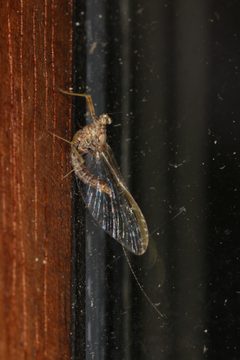
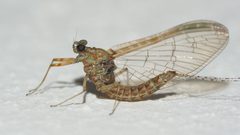
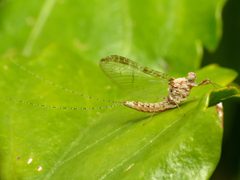
Cloeon is a of mayflies in the Baetidae, commonly known as Double-gilled Pond Creepers. in this genus are aquatic as larvae (naiads) and inhabit diverse freshwater environments. At least one species, C. dipterum, is known to give birth to live naiads rather than laying externally. The genus has been studied for its to environmental stressors including temperature and oxygen fluctuations.
Pronunciation
How to pronounce Cloeon: //ˈkloʊ.iːˌɒn//
These audio files are automatically generated. While they are not always 100% accurate, they are a good starting point.
Identification
Four Chinese have been characterized by female color patterns of the stigma and : C. dipterum and C. harveyi share similar pigmented stigma and striped abdominal sterna, while C. viridulum and C. bicolor lack both pigmented stigma and abdominal sternal stripes. Detailed identification requires examination of female abdominal and wing markings.
Images
Habitat
Aquatic; larvae inhabit shallow areas with submerged aquatic weeds that provide shelter and abundant oxygen supply. Some occupy flowing water environments where larvae exhibit specific swimming and positioning in response to current.
Distribution
distribution including tropical lakes, the British Isles, China, Thailand, and North America (Vermont, US). Records from Denmark, Norway, and Sweden.
Life Cycle
Aquatic larval stage (naiad) lasts from months to years depending on . emerge through a subimago (dun) stage followed by a final to the sexually mature (spinner). At least one species, C. dipterum, has been observed to give birth to live naiads after internal incubation rather than laying eggs externally.
Behavior
Larvae are mobile and capable of relocating within their , moving from areas of high temperature and low oxygen to shallows with submerged aquatic weeds— significant to their microdistribution. Larvae exhibit specific swimming and positioning behaviors in flowing water, studied through behavioral hydrodynamics research.
Ecological Role
As part of the Ephemeroptera, larvae contribute to EPT (Ephemeroptera-Plecoptera-Trichoptera) biological indices used for water quality assessment in environmental health monitoring. in this indicates healthy aquatic .
Human Relevance
are used by fly fishermen as models for imitation flies, with subimagos called "duns" and imagos called "spinners." Larvae are studied for their to environmental stressors, providing data for water quality assessment.
Similar Taxa
- CallibaetisBoth are Baetidae mayflies with similar small minnow-like appearance; Cloeon distinguished by specific larval preferences and some ' live-bearing .
- CaenisBoth are small mayflies; Cloeon larvae lack the square-gilled characteristic of Caenis.
More Details
Taxonomic Complexity
Chinese fauna review (2021) resolved several synonymies: C. apicatum Navás, 1933 and C. pielinum Navás, 1933, plus C. micki Tong and Dudgeon, 2021, are synonymized with C. viridulum Navás, 1931. C. virens Klapá, 1905 from Chinese mainland is also recognized as a distinct .
Environmental Tolerance
Laboratory studies on C. perkinsi larvae demonstrated wide temperature (7.5°C to 35°C LC50 limits) and oxygen tolerance (mean 24-hour LC50 of 4.35 mg/L), consistent with findings for related in tropical lakes.
Sources and further reading
- BugGuide
- Wikipedia
- GBIF taxonomy match
- iNaturalist taxon
- NCBI Taxonomy
- Catalogue of Life
- Bug Eric: The Mayfly Analogy
- Behavioural Hydrodynamics of Cloeon dipterum Larvae (Ephemeroptera:Baetidae)
- The Biology of Cloeon cognatum (Ephemeroptra Baetidae)
- Oxygen and temperature tolerance in Cloeon perkensi larvae (Ephemeroptera: Baetidae)
- A Review of the Genus Cloeon from Chinese Mainland (Ephemeroptera: Baetidae)
- Taxonomic insights into the diversity of Cloeon Leach, 1815 (Ephemeroptera, Baetidae) in Thailand.
- First report of mitochondrial genome of Cloeon viridulum (Ephemeroptera: Baetidae) from Hebei, China.