
Anthopotamus
McCafferty & Bae, 1990
hacklegilled burrower mayflies
Species Guides
4- Anthopotamus distinctus(Golden Drake)
- Anthopotamus myops(hacklegilled burrower mayfly)
- Anthopotamus neglectus
- Anthopotamus verticis(Walker's Tusked Sprawler)
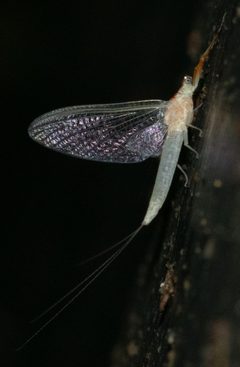
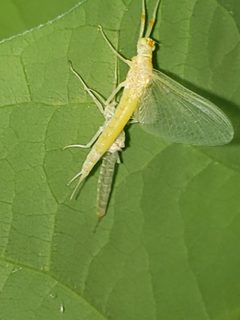
Anthopotamus is a of hacklegilled burrower in the Potamanthidae, established by McCafferty & Bae in 1990. The genus contains at least four described distributed in North America. Larvae are specialized burrowers in riverine substrates, notable for their lifestyle in the hyporheic zone using tusk-like structures for excavation. are short-lived and primarily reproductive.
Pronunciation
How to pronounce Anthopotamus: //ænˌθoʊˈpætəməs//
These audio files are automatically generated. While they are not always 100% accurate, they are a good starting point.
Identification
Larvae identified by combination of: tusk-like mandibular projections for excavation; hacklegills (first gill pair operculate, covering others); habit in spaces without tube construction; preference for coarse gravel to small pebble substrates. require identification; separation from other Potamanthidae based on genitalia and wing venation details.
Images
Habitat
Riverine systems, specifically the hyporheic zone—the saturated space beneath and alongside river channels. Larvae inhabit coarse gravel to small pebble substrates, avoiding coarse sand or finer particles. Microdistribution limited by substrate particle size; often found at interfaces between large rocks and finer substrates. Depth in substrate varies by larval size class.
Distribution
North American riverine systems. Documented from Indiana (Tippecanoe River) and inferred across temperate North American rivers based on records.
Seasonality
Larval growth and development primarily March to August. protracted from mid-July to mid-August. Major recruitment of new larvae in August. Overwinters as young larvae. tied to seasonal temperature patterns.
Life Cycle
with single cohort per year. Larval growth concentrated March–August. Protracted mid-July to mid-August. Major larval recruitment occurs August. Overwinters predominantly as young larvae. has been described. Wing pad development shows exponential relationship with body size and serves as efficient maturation indicator.
Behavior
Larvae are obligate burrowers in spaces, using tusks to actively excavate substrate. Gills generate interstitial water currents for ventilation and/or filter feeding. Unlike other ephemeroid burrowers, does not form tube burrows. Size-class stratification by substrate depth: smaller larvae occur deeper in finer substrates than larger larvae.
Ecological Role
dweller contributing to hyporheic zone bioturbation through burrowing activity. Potential food source in riverine . Part of the specialized fauna adapted to hyporheic , indicating functional connectivity between surface and groundwater .
Similar Taxa
- Other Potamanthidae generaShare hacklegill configuration and burrowing habits; distinguished by larval tusk , substrate preferences, and genitalia
- Ephemeridae (common burrowers)Also burrowing ephemeroids but construct U-shaped tube burrows in mud or sand; Anthopotamus lacks tube construction and prefers coarser substrates
More Details
Taxonomic note
established 1990 by McCafferty & Bae; previously included were transferred from other genera. Contains four described species: A. distinctus, A. myops, A. neglectus, and A. verticis.
Research limitations
Detailed information available only for A. verticis from Tippecanoe River, Indiana. Other and may differ in and microhabitat use.