
Tricorythodes
Ulmer, 1920
little stout crawler mayflies
Species Guides
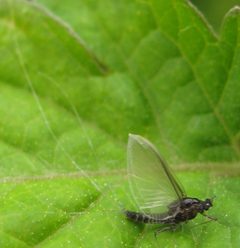
1Tricorythodes is a of small, robust mayflies in the Leptohyphidae, commonly known as little stout crawler mayflies. The genus comprises approximately 16 described distributed across the Americas. Nymphs are primarily found in stream where they function as collector-gatherers, processing fine particulate organic matter. Species within this genus exhibit multivoltine with development rates strongly influenced by temperature.
Pronunciation
How to pronounce Tricorythodes: //traɪˌkɔːrɪˈθoʊdiːz//
These audio files are automatically generated. While they are not always 100% accurate, they are a good starting point.
Identification
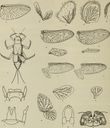
Nymphs can be distinguished from the morphologically similar Caenis by preferences: Tricorythodes occurs in wide rivers with coarse substrates, whereas Caenis is typically found in different riverine conditions. Nymphs possess operculate gills; in some , these gills display a clear paler anterolateral area. Fore tarsal claws bear marginal denticles (10–13 in some species) and submarginal denticles. and nymphs of certain species exhibit subapical blackish marks on the tibiae and body color patterns formed by irregularly distributed pigments.
Images
Habitat
Nymphs inhabit lotic freshwater systems, specifically wide rivers of varying depths with coarse substrates, as well as small streams with stony substrate and thick sand. specificity distinguishes this from similar .
Distribution
distributed in the Americas, with records from North America (Interior Plains of Alberta, Canada), Central America ( Rica), and South America (Uruguay, Colombia). Specific distribution varies by .
Diet
Collector-gatherer functional feeding group; nymphs consume fine particulate organic matter. Laboratory studies on T. minutus demonstrate ingestion rates varying with food type, with assimilation efficiencies of 33–57% depending on algal food source.
Life Cycle
Multivoltine; time and development rates are strongly temperature-dependent. Growth rates are notably rapid compared to other mayflies, with instantaneous growth rates higher than most ephemeropteran studied.
Behavior
Nymphs are -type, adapted to coarse substrates in riverine environments. Rapid gut clearance (approximately 30 minutes) has been documented in T. minutus.
Ecological Role
Collector-gatherer in stream ; processes fine particulate organic matter and contributes to energy transfer in lotic . High ingestion and growth rates relative to other mayflies suggest substantial contribution to secondary production.
Similar Taxa
Sources and further reading
- BugGuide
- Wikipedia
- GBIF taxonomy match
- iNaturalist taxon
- NCBI Taxonomy
- Catalogue of Life
- A new species of Tricorythodes Ulmer (Ephemeroptera: Leptohyphidae) from Uruguay
- Habitat characterization of the morphologically similar mayfly larvae, Caenis and Tricorythodes (Ephemeroptera)
- Bioenergetics of a stream “collector” organism, Tricorythodes minutus (Insecta: Ephemeroptera)1,2
- Life History of a Multivoltine Mayfly, Tricorythodes minutus:11 an Example of the Effect of Temperature on the life Cycle2