
Holorusia hespera
Arnaud & Byers, 1990
Giant Western Crane Fly
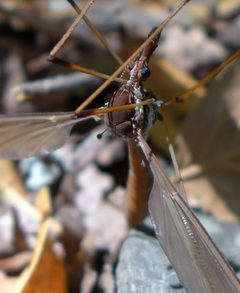
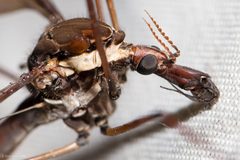
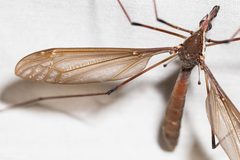
Holorusia hespera is the largest crane fly in North America, with wings reaching 40 mm in length. It is distinguished by its amber-colored wings that lack the interference patterns common in other crane flies, a feature attributed to wing thickness. The wing surfaces display ridging and folds with uniform coloration. This western Nearctic species belongs to a that includes some of the largest crane flies globally.
Pronunciation
How to pronounce Holorusia hespera: /həˈlɔːruːsiə ˈhɛspərə/
These audio files are automatically generated. While they are not always 100% accurate, they are a good starting point.
Identification
Distinguished from other crane flies by its exceptional size (40 mm wing length versus typically much smaller relatives). The absence of wing interference patterns on the amber wing surface is diagnostic—most crane flies show iridescent or patterned wing surfaces. The uniformly colored, ridged wing texture further separates it from and other Tipulidae.
Images
Distribution
Western North America: Alaska, British Columbia, California, Arizona, Idaho, and Utah. Nearctic region.
Similar Taxa
- Other Tipulidae speciesMost crane flies are significantly smaller and display wing interference patterns absent in H. hespera
- Holorusia mikadoAsian of comparable large size, but geographically separated (Eastern Palearctic/Oriental versus Nearctic distribution)
More Details
Wing structure
The absence of interference patterns in H. hespera has been attributed to wing thickness, representing a structural rather than pigmentary difference from patterned relatives
Sources and further reading
- BugGuide
- Wikipedia
- GBIF taxonomy match
- iNaturalist taxon
- NCBI Taxonomy
- Catalogue of Life
- Bug Eric: New Mexico Dragonfly Blitz - Day 2
- When is a stag beetle not a stag beetle? | Beetles In The Bush
- Typocerus deceptus in Missouri | Beetles In The Bush
- Detailed description and illustration of larva, pupa and imago of Holorusia mikado (Westwood, 1876) (Diptera: Tipulidae) from Japan