
Toxorhina magna
Osten Sacken, 1865
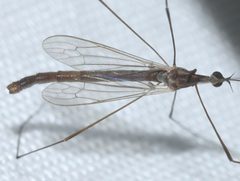
Toxorhina magna is a of limoniid crane fly found in eastern North America. are characterized by yellowish-brown coloration, which distinguishes them from the grayish Toxorhina muliebris. The species has been documented from the Atlantic coast west to Michigan and south to Florida. Like other crane flies, it belongs to a group of delicate, long-legged flies whose larvae typically develop in moist soil or decaying organic matter.
Pronunciation
How to pronounce Toxorhina magna: /tɔksɔˈriːnə ˈmæɡnə/
These audio files are automatically generated. While they are not always 100% accurate, they are a good starting point.
Identification
The yellowish-brown coloration is the most reliable field mark distinguishing Toxorhina magna from Toxorhina muliebris, which is grayish in color. Where their ranges overlap in the northern portion of T. magna's distribution, coloration provides the most obvious separation between these two .
Images
Appearance
exhibit yellowish-brown body coloration. The overall body form is characteristic of limoniid crane flies: elongated and delicate with long, slender legs. Wings are present and functional, with typical dipteran venation patterns for the .
Distribution
Eastern United States from the Atlantic coast west to Michigan, south to Florida, and west to Kansas, Louisiana, and Florida. The occurs in the Nearctic region with records from both the United States and Canada.
Similar Taxa
- Toxorhina muliebrisOverlaps in northern part of T. magna's range; distinguished by grayish coloration versus yellowish-brown in T. magna
More Details
Taxonomic Note
Toxorhina magna was described by Osten Sacken in 1865. The Toxorhina is classified within the Limoniidae, a large family of crane flies formerly treated as a of Tipulidae.