
Tetanops
Fallén, 1820
picture-winged flies
Species Guides
5- Tetanops integer
- Tetanops luridipennis
- Tetanops magdalanae
- Tetanops myopaeformis(sugar beet root maggot)
- Tetanops parallelus
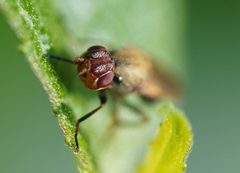
Tetanops is a of picture-winged flies ( Ulidiidae, Otitinae) containing approximately 20 described distributed across the Holarctic region. The genus includes both economically significant agricultural pests and non-pest species with specialized ecological associations. The most intensively studied species, Tetanops myopaeformis (sugar beet ), is a major pest of sugar beet in North America, while other species such as T. myopina are psammophilous inhabiting coastal sand dunes. Larval varies substantially among species: some develop in living plant roots, others in decaying organic matter, and at least one species is associated with rotting cactus pads.
Pronunciation
How to pronounce Tetanops: /ˈtiː.təˌnɒps/
These audio files are automatically generated. While they are not always 100% accurate, they are a good starting point.
Identification
Tetanops are distinguished from other Ulidiidae by a combination of structural features including shape, wing venation patterns, and genitalic . Species-level identification typically requires examination of male terminalia and wing pattern details. The genus is placed in Otitinae based on characteristic features of the head capsule and . Wing patterns in Tetanops generally show reduced ornamentation compared to more conspicuously marked ulidiid genera such as Ceroxys or Delphinia.
Images
Habitat
associations vary by . Tetanops myopaeformis occurs in agricultural fields and adjacent areas with suitable plants. Tetanops myopina inhabits coastal sand dunes of the Irish, North and Baltic Seas, with isolated inland in sandpits. Other species have been recorded from various terrestrial habitats including sandy soils, decaying vegetation, and cactus-dominated in the southwestern United States.
Distribution
The has a Holarctic distribution. Tetanops myopaeformis occurs in North America from southern Alberta and Manitoba south through the north-central and western United States (North Dakota, Idaho, Montana, Wyoming, Utah, Colorado). Tetanops myopina is distributed across coastal regions of northwestern Europe (Ireland, Wales, Scandinavia, Baltic coast) with disjunct inland in the Czech Republic. GBIF records indicate presence in Denmark, Norway, and Sweden for the genus overall.
Seasonality
activity periods vary by and latitude. In southern Alberta, Tetanops myopaeformis adults emerge from larvae with peak typically occurring in late spring to early summer. In Colorado, Tetanops species have been observed active in spring and fall. The freeze-tolerant third-instar larvae of T. myopaeformis overwinter in soil, with some individuals capable of prolonged lasting multiple years.
Diet
Larval diet varies substantially among . Tetanops myopaeformis larvae feed on roots of sugar beet (Beta vulgaris ssp. vulgaris) and can complete development on other non-native plant species, though the native remains unidentified. The larval diet of most other Tetanops species is poorly documented; T. myopina is presumed to have associations with psammophilous vegetation based on .
Host Associations
- Beta vulgaris ssp. vulgaris (sugar beet) - primary For T. myopaeformis; larval development occurs in roots
- Non-native plant species - alternative T. myopaeformis can complete on other plants, but native unidentified
Life Cycle
Tetanops myopaeformis has a with some individuals exhibiting prolonged . are laid in soil near plants. Larvae develop through three instars, feeding on host roots. Third-instar larvae enter diapause and overwinter in soil, showing freeze . emerge in spring to summer. Some larvae may remain in diapause or post-diapause for over five years under laboratory conditions. Life cycle details for other Tetanops are largely unknown.
Behavior
Tetanops myopaeformis are attracted to yellow and white traps, with water traps containing wetting agent effective for monitoring. Larval includes root penetration and feeding within root tissue. T. myopaeformis larvae exhibit supercooling point plasticity during cold storage, with freezing events resetting thermal parameters. Adult behavior of most is poorly documented.
Ecological Role
Tetanops myopaeformis functions as a primary consumer (herbivore) in agricultural , with significant economic impact on sugar beet production. The serves as a model organism for studying plant-insect interactions, insect freeze , and resistance mechanisms. Non-pest species likely contribute to nutrient cycling through larval feeding on decaying organic matter or as specialized herbivores in native ecosystems.
Human Relevance
Tetanops myopaeformis is a major agricultural pest, causing the most severe damage to sugar beet of any insect in North America. Yield losses can reach 100% locally. The is the subject of intensive research on , , and . Economic impact extends to global sugar production, with sugar beet accounting for approximately 35% of world raw sugar. Other Tetanops species have no documented economic significance.
Similar Taxa
- CeroxysSimilar size and general body form; distinguished by more elaborate wing patterns with distinct bars and different genitalic structure
- DelphiniaSimilar associations and body size; distinguished by wing pattern details and
- Tephritidae (fruit flies)Superficially similar wing patterns in some ; distinguished by -level characters of structure, wing venation, and larval
More Details
Bacterial Symbiosis
Tetanops myopaeformis maintains two distinct bacterial symbiotic relationships. Serratia liquefaciens and Serratia marcescens are associated with all developmental stages and transmitted vertically from male to female , with both internal infiltration and external egg smearing during oviposition. Pseudomonas maltophilia is associated with the larval gut and puparial inner surface, producing that appear to facilitate through puparial degradation.
Genomic Resources
Draft assemblies are available for T. myopaeformis (TmSBRM_v1.0 and TpSBRM_v1.0), enabling transcriptomic studies of - interactions and differential under and susceptible sugar beet responses. Transcriptome data cover timepoints from 0 to 72 hours post-.
Taxonomic History
The Ulidiidae was formerly known as , and older literature may use this name. The Tetanops was established by Fallén in 1820 and includes two subgenera: Tetanops (sensu stricto) and Eurycephalomyia (Hendel, 1907).
Sources and further reading
- BugGuide
- Wikipedia
- GBIF taxonomy match
- iNaturalist taxon
- NCBI Taxonomy
- Catalogue of Life
- Bug Eric: Picture-winged Flies
- Host Plants of the Sugarbeet Root Maggot, Tetanops myopaeformis1, 2
- Bacterial Symbionts in the Sugar Beet Root Maggot, Tetanops myopaeformis (von Röder)
- Transcriptome sample statistics for the sugar beet root maggot Tetanops myopaeformis ) infecting sugar beet
- Tetanops myopina Fallén, 1820, a psammophilous species of Otitinae (Diptera: Ulidiidae) found in a sandpit in the northeastern part of the Czech Republic/ Tetanops myopina Fallén, 1820, psamofilní druh čelnice z podčeledi Otitinae (Diptera: Ulidiidae) nalezený v pískovně v severovýchodní části České republiky
- An assembly of genomic dataset sequences of the sugar beet root maggot Tetanops myopaeformis , TpSBRM_v1.0
- Life History of the Sugar-Beet Root Maggot Tetanops myopaeformis (Röder) (Diptera: Otitidae) in Southern Alberta
- Transcriptome analysis of sugar beet root maggot (Tetanops myopaeformis) genes modulated by the Beta vulgaris host
- Reliability of Trapping in Determining the Emergence Period and Sex Ratio of the Sugar-beet Root Maggot Tetanops myopaeformis (Röder) (Diptera: Otitidae)
- Transcriptome sample statistics of the responses the sugar beet root maggot, Tetanops myopaeformis has while experiencing susceptible and resistant reactions with sugar beet, Beta vulgaris ssp. vulgaris
- Supercooling point plasticity during cold storage in the freeze‐tolerant sugarbeet root maggot Tetanops myopaeformis
- Deep learning analysis of sugar beet (Beta vulgaris ssp vulgaris) protease inhibitors interacting with identified trypsins from its primary pathogen, the sugar beet root maggot Tetanops myopaeformis.
- The annotation of genomic dataset sequences of the sugar beet root maggot Tetanops myopaeformis, TmSBRM_v1.0.
- A de novo assembly of genomic dataset sequences of the sugar beet root maggot Tetanops myopaeformis, TmSBRM_v1.0.