
Strauzia longipennis
(Wiedemann, 1830)
sunflower maggot fly, sunflower maggot
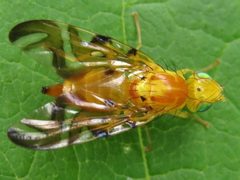
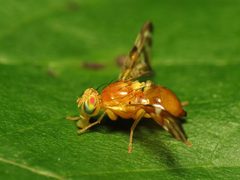
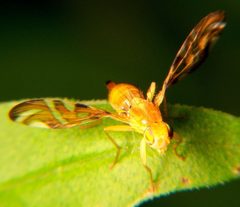
Strauzia longipennis is a large tephritid fruit fly commonly known as the sunflower maggot fly. It is a minor agricultural pest whose larvae mine the stems of sunflowers (Helianthus spp.), causing typically light damage to spongy tissue. Unlike related sunflower-feeding tephritids, its larvae do not attack flower or seeds. The exhibits notable morphological variability and may represent a complex of incipient species or races.
Pronunciation
How to pronounce Strauzia longipennis: /ˈstra͡ʊziə lɒnˈd͡ʒiːpɛnɪs/
These audio files are automatically generated. While they are not always 100% accurate, they are a good starting point.
Identification
Distinguished from other sunflower-feeding tephritids by larval feeding location (stems vs. or seeds). separable from Gymnocarena diffusa and Neotephritis finalis by wing pattern and larval damage . The F-shaped wing marking is a key visual diagnostic. Genetic studies have identified two sympatric lineages in eastern Iowa (corresponding to former varieties typica and vittigera) that may represent cryptic .
Images
Appearance
are relatively large for Tephritidae, approximately 6 mm in body length with wings around 7 mm. The body is yellow to orange. The wing displays orange to brown bands that usually form a distinct F-shaped marking near the wing tip. Larvae are yellowish-white, reaching about 5 mm in length.
Habitat
Associated with sunflower-growing areas; agricultural fields, roadsides, and other where Helianthus occur. Specific microhabitat requirements beyond plant presence are not well documented.
Distribution
North America: widespread across USA (Arizona, California, Colorado, Connecticut, Idaho, Illinois, Indiana, Iowa, Kansas, Maine, Maryland, Massachusetts, Michigan, Minnesota, Mississippi, Missouri, Montana, Nebraska, New Jersey, New Mexico, North Carolina, North Dakota, Ohio, Oregon, Pennsylvania, South Dakota, Texas, Utah, Vermont, Virginia, Wisconsin) and Canada (Alberta, Manitoba, Ontario, Quebec). Europe: Germany (introduced or established).
Seasonality
active from May to August, with timing varying by location. Larval development within stems lasts approximately 30 days. Pupae overwinter in plant bases or soil.
Diet
Larvae mine stems of sunflowers (Helianthus spp.), feeding on spongy tissue. Specific feeding habits are not documented in available sources.
Host Associations
- Helianthus annuus - larval Primary ; larvae mine stems
- Helianthus spp. - larval -level association
Life Cycle
laid on or near sunflower stems. Larvae feed internally in stems for approximately 30 days. occurs in base of plant or in soil, with pupae . emerge in spring to mid-summer. Single or partial per year depending on location.
Behavior
Larvae are endophytic stem miners. have been observed from May through August. No specific adult such as mating displays or patterns are documented in available sources.
Ecological Role
Minor herbivore of native and cultivated sunflowers. Larval mining creates limited damage to spongy stem tissue. Does not damage seeds or flower , reducing economic impact compared to other sunflower tephritids.
Human Relevance
Minor agricultural pest of sunflower crops. Damage is typically light and limited to spongy stem tissue; does not affect yield-significant plant parts (seeds, flower ). Often confused with more damaging sunflower-feeding tephritids. Genetic research on this has contributed to understanding of incipient speciation and race formation.
Similar Taxa
- Gymnocarena diffusaAlso called 'sunflower maggot'; distinguished by larval feeding in flower rather than stems
- Neotephritis finalisSunflower seed maggot; distinguished by larval feeding on developing seeds rather than stems
Misconceptions
The 'sunflower maggot' is shared with two other tephritid (Gymnocarena diffusa and Neotephritis finalis), causing confusion about which species causes which type of damage. Strauzia longipennis does NOT damage flower or seeds, contrary to what the shared name might imply.
More Details
Taxonomic complexity
S. longipennis exhibits high morphological variability; seven varieties were historically recognized, three elevated to status. Two sympatric mitochondrial lineages (corresponding to former varieties typica and vittigera) occur in eastern Iowa, suggesting incipient speciation or race formation.
Sources and further reading
- BugGuide
- Wikipedia
- GBIF taxonomy match
- iNaturalist taxon
- NCBI Taxonomy
- Catalogue of Life
- Grasshoppers of Colorado
- Grasshoppers of Colorado
- Grasshoppers of Colorado
- Grasshoppers of Colorado
- List of Species Fact Sheets| Grasshoppers of Wyoming and the West
- High Plains Grasshopper
- Strauzia longipennis . [Distribution map].
- Incipient Speciation in Strauzia longipennis (Diptera: Tephritidae): Two Sympatric Mitochondrial DNA Lineages in Eastern Iowa