
Neotephritis finalis
(Loew, 1862)
Sunflower Seed Maggot
Neotephritis finalis, commonly known as the sunflower seed maggot, is a tephritid fly that is a significant pest of cultivated sunflower (Helianthus annuus) in North America. emerge in late June to early July, mate on sunflower , and females oviposit into developing heads during the R3-R4 growth stages. Larvae feed gregariously on developing seeds from July through August, causing direct damage that reduces seed quality and yield. The completes one per year, with third instar larvae exiting heads to pupate in soil and overwinter as pupae.
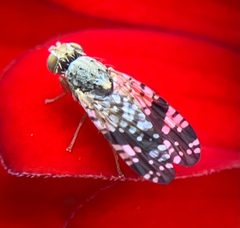
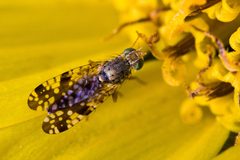
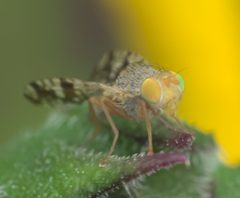
Pronunciation
How to pronounce Neotephritis finalis: /ˌniːoʊˈtɛf.rɪ.tɪs fɪˈnaɪ.lɪs/
These audio files are automatically generated. While they are not always 100% accurate, they are a good starting point.
Identification
can be distinguished from other tephritid flies by their association with sunflower fields and their seasonal ( in late June to early July). The is most reliably identified by rearing larvae from sunflower and examining adult specimens. Within the Neotephritis, N. finalis is specifically associated with Helianthus annuus as a larval . Patterned wings typical of Tephritidae may aid in -level identification, but species-level identification requires expert examination or association with host plant and geographic location.
Images
Habitat
Agricultural areas where cultivated sunflower (Helianthus annuus) is grown. are found in weedy areas adjacent to sunflower fields before crop flowering, then migrate to sunflower fields when plants reach reproductive stages. The is closely tied to agricultural and does not appear to persist in natural without sunflower presence.
Distribution
Canada (Saskatchewan, specifically recorded from the Saskatoon area), USA, and Mexico. The is distributed across North America in regions where cultivated sunflower is grown.
Seasonality
emerge from pupae in late June to early July. Mating occurs shortly after on sunflower . Oviposition takes place in July into sunflower heads at R3-R4 growth stages. Larval development occurs from July through August. Third instar larvae exit heads in August to pupate in soil. One per year (), with adults of the next generation emerging the following year.
Diet
Larvae feed on developing seeds of cultivated sunflower (Helianthus annuus). feed on nectar and pollen of various non- flowers including Cirsium arvense (Canada thistle), Sonchus arvensis ( sow-thistle), and Taraxacum officinale (dandelion) before sunflower bloom, then migrate to sunflower fields where they feed on sunflower pollen and nectar.
Host Associations
- Helianthus annuus - primary cultivated sunflower; larval feeding site on developing seeds
- Cirsium arvense - food sourceCanada thistle; nectar and pollen source before sunflower bloom
- Sonchus arvensis - food source sow-thistle; nectar and pollen source before sunflower bloom
- Taraxacum officinale - food sourcedandelion; nectar and pollen source before sunflower bloom
Life Cycle
(one per year). are laid in sunflower in July. Larvae develop through three instars, feeding on seeds from July through August for 18-24 days at 25°C. Third instar larvae exit heads and drop to the soil, burrowing 2-5 cm deep to form earthen and pupate. Pupae overwinter in soil. emerge late June to early July the following year, with a pre-oviposition period of 7-10 days.
Behavior
exhibit strong phototactic response. Mating occurs on plant sunflower . Females use their ovipositor to insert into developing sunflower heads, preferring heads at R3-R4 growth stages (disk flowers present, ray flowers open). Larvae feed gregariously within sunflower heads. Third instar larvae actively exit heads and burrow into soil for . Adults feed on non-host flowers before sunflower bloom, then migrate to sunflower fields when hosts become available.
Ecological Role
Agricultural pest causing direct damage to sunflower seeds through larval feeding, reducing seed quality and yield in cultivated sunflower. The functions as a herbivore in agroecosystems, with no documented role in natural beyond agricultural contexts.
Human Relevance
Economic pest of commercial sunflower , particularly in the northern Great Plains of North America. Larval feeding on developing seeds reduces yield and seed quality for both oilseed and confectionery sunflower production. Management is relevant to agricultural programs.
Similar Taxa
- Gymnocarena diffusaAlso a tephritid fly associated with sunflower, known as the sunflower receptacle maggot; distinguished by feeding on receptacle tissue rather than seeds, and by timing and -laying (eggs laid between bract layers rather than in florets)
- Other Neotephritis speciesCongeneric may occur in similar but differ in plant associations; N. finalis is specifically associated with Helianthus annuus as a larval host
More Details
Phenology and Crop Management
The ' and strict dependence on sunflower at specific growth stages (R3-R4) creates a narrow window for management intervention. The pre-oviposition period of 7-10 days after provides a potential monitoring and management window before are laid.
Research History
The stages were formally described and illustrated in a 1989 paper in The Canadian Entomologist, which also provided the first detailed biological notes for the in Saskatchewan, Canada. Prior to this work, the species was known primarily from specimens and agricultural damage reports.
Sources and further reading
- BugGuide
- Wikipedia
- GBIF taxonomy match
- iNaturalist taxon
- NCBI Taxonomy
- Catalogue of Life
- Bug Eric: More Insects From Sunflowers
- How to Get Started in Ento-preneurship
- 🥳 Here goes THE title in our New Species Showdown!
- ID challenge | Beetles In The Bush | Page 3
- Greenhouse gas | Blog
- DESCRIPTION OF THE IMMATURE STAGES AND NOTES ON THE BIOLOGY OF NEOTEPHRITIS FINALIS (LOEW.) (DIPTERA: TEPHRITIDAE), A PEST OF SUNFLOWERS IN SASKATCHEWAN, CANADA