
Neotephritis
Hendel, 1935
sunflower seed maggot
Species Guides
2- Neotephritis finalis(Sunflower Seed Maggot)
- Neotephritis rava
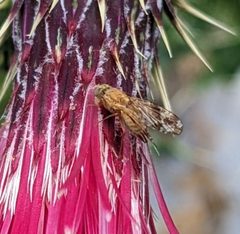
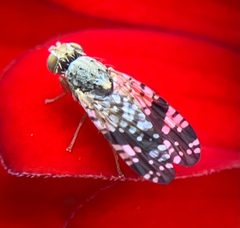
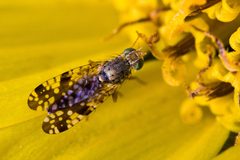
Neotephritis is a of tephritid fruit flies established by Hendel in 1935. The genus contains approximately 12 described distributed in the Americas. At least one species, Neotephritis finalis, is a documented pest of cultivated sunflowers, with larvae feeding within developing flower and reducing seed set. are characterized by patterned wings typical of Tephritidae, often with dark markings and hyaline spots.
Pronunciation
How to pronounce Neotephritis: /ˌniː.oʊˈtɛf.rɪ.tɪs/
These audio files are automatically generated. While they are not always 100% accurate, they are a good starting point.
Identification
Members of Neotephritis possess the diagnostic wing patterns characteristic of Tephritidae, typically with dark pigmentation in the half and distinct hyaline spots. N. finalis specifically has six hyaline spots forming a distinct triangle in the dark apical wing region. Separation from other tephritid requires examination of wing venation and genitalic structures; the genus is distinguished within Tephritini by combinations of setal patterns and wing markings.
Images
Habitat
Agricultural and natural areas with plants in the sunflower (Asteraceae). N. finalis has been documented in stands of native sunflowers and commercial sunflower .
Distribution
New World distribution; recorded from North America (including Canada and the United States) and South America. Specific distribution varies by species; N. finalis occurs in Saskatchewan, Canada, and across much of North America.
Seasonality
N. finalis first appears around early July in northern regions. Two are produced per season in areas where it has been studied.
Diet
Larvae feed internally on developing sunflower seeds and florets. of N. finalis have been observed feeding on extrafloral .
Host Associations
- Helianthus annuus - larval cultivated and native sunflower
- Asteraceae - larval development occurs in sunflower
Life Cycle
are laid around the corollas of partially opened florets. Larvae feed within undeveloped ovaries of flowers, reducing seed set. occurs either within the flower (first ) or in soil (second generation, which overwinters). Two generations per season have been documented for N. finalis.
Behavior
females oviposit on sunflower during the flowering stage. Larval feeding is internal and concealed within developing seeds. Mature larvae exit the head to pupate in soil or may pupate within the head.
Ecological Role
Phytophagous herbivore in native sunflower ; agricultural pest in commercial sunflower .
Human Relevance
N. finalis is recognized as a pest of commercial sunflower crops, with larval feeding reducing seed yield. No other documented human interactions for the .
Similar Taxa
- Gymnocarena diffusaAlso a tephritid fly associated with sunflowers; differs in larval feeding site (receptacle tissue vs. seeds in Neotephritis) and wing pattern
- TephritisLarger of Tephritidae with similar wing patterns; requires detailed morphological examination to distinguish
Sources and further reading
- BugGuide
- Wikipedia
- GBIF taxonomy match
- NCBI Taxonomy
- Catalogue of Life
- Presenting: A Butterfly and a Fly | Bug Squad
- Bug Eric: More Insects From Sunflowers
- DESCRIPTION OF THE IMMATURE STAGES AND NOTES ON THE BIOLOGY OF NEOTEPHRITIS FINALIS (LOEW.) (DIPTERA: TEPHRITIDAE), A PEST OF SUNFLOWERS IN SASKATCHEWAN, CANADA