
Rhagoletis meigenii
(Loew, 1844)
barberry fly, yellow berberis fruit fly
Rhagoletis meigenii, commonly known as the barberry fly or yellow berberis fruit fly, is a tephritid fruit fly native to Europe, the Near East, and Central Asia. It has been introduced to the , specifically in Nova Scotia, Canada, and the northeastern United States. are active during summer months and are associated with barberry plants.
Pronunciation
How to pronounce Rhagoletis meigenii: /ræɡoʊˈliːtɪs maɪˈɡɛni.aɪ/
These audio files are automatically generated. While they are not always 100% accurate, they are a good starting point.
Identification
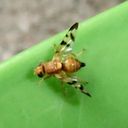
Distinguished from other Rhagoletis by the combination of: cream to yellow scutellum (not white), orange-yellow body background color, and specific wing banding pattern with , preapical, discal, and accessory costal crossbands present. The two pairs of orbital setae separate it from some . Similar species R. completa (walnut husk fly) has a yellowish-white scutellum and triangular wing pattern, and feeds on walnut rather than barberry.
Images
Appearance
Body length 8–10 mm. Background body color orange-yellow. Wings with prominent dark bands including an crossband, preapical crossband, discal crossband, and accessory costal crossband. with two pairs of orbital setae. Scutellum typically cream to yellow in color.
Habitat
Associated with plant Berberis vulgaris (common barberry). Found in where this host occurs, including woodland edges, hedgerows, and areas with naturalized or cultivated barberry.
Distribution
Native to most of Europe (Austria, Belgium, Czech Republic, Denmark, Estonia, Finland, France, Germany, Hungary, Italy, Latvia, Lithuania, Norway, Poland, Slovakia, Spain, Sweden, Switzerland, The Netherlands, Ukraine, United Kingdom), the Near East, and Central Asia. Introduced to Nearctic region: Canada (Nova Scotia) and USA (Maine, New Hampshire).
Seasonality
active July to August.
Diet
feed on pollen and nectar. Larvae feed on fruit seeds of Berberis vulgaris.
Host Associations
- Berberis vulgaris - larval Larvae feed on fruit seeds
Life Cycle
Larval development occurs within fruits of Berberis vulgaris, feeding on seeds. Specific details of and not documented in available sources.
Ecological Role
Seed of Berberis vulgaris. Potential ecological impact in introduced range through reduction of barberry seed viability.
Human Relevance
No direct economic significance to agriculture documented. Association with Berberis vulgaris, which is itself considered in some regions, may create ecological interactions of management interest. No known medical or forensic importance.
Similar Taxa
- Rhagoletis completaSimilar wing banding pattern and yellowish body coloration, but R. completa has triangular wing pattern and yellowish-white scutellum; feeds on walnut (Juglans) rather than barberry
More Details
Taxonomic note
Described by Loew in 1844. The specific epithet 'meigenii' honors the German entomologist Johann Wilhelm Meigen, a pioneer in dipteran .