
Rhagoletis completa
Cresson, 1929
Walnut Husk Fly
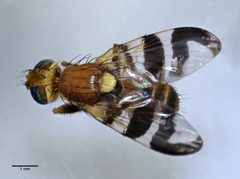
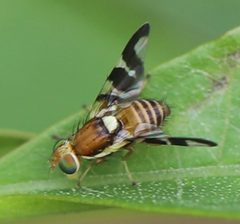
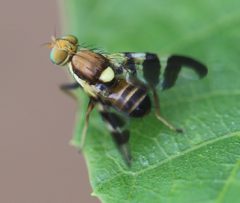
Rhagoletis completa, the walnut husk fly, is a tephritid fruit fly native to central North America and now established in Europe. It is the most economically significant pest of walnut (Juglans regia) production, causing yield losses up to 80% through larval feeding on husk tissue. emerge over a prolonged period from mid-May to October and are distinguished by a dark triangular wing pattern and yellowish-white scutellum. The has one per year, with larvae pupating in soil and a small proportion entering prolonged dormancy.
Pronunciation
How to pronounce Rhagoletis completa: /rəˈɡoʊlətɪs kəmˈpliːtə/
These audio files are automatically generated. While they are not always 100% accurate, they are a good starting point.
Identification
are identified by the combination of yellowish-brown body coloration, dark triangular wing pattern, and yellowish-white scutellum. This wing pattern distinguishes R. completa from other walnut-infesting Rhagoletis such as R. zoqui. Larvae are creamy-white maggots found within walnut husks. Oviposition punctures on husk tissue may be visible as small dark spots.
Images
Habitat
Walnut orchards and areas with wild or cultivated walnut trees (Juglans spp.). are found on walnut foliage and fruit . Larvae develop within walnut husks. occurs in the upper 10 cm of soil beneath trees.
Distribution
Native to central United States. Established in western North America including California, Oregon, Washington, and southwestern states. Introduced and spreading in Europe including Italy, France, Germany, Austria, Switzerland, Croatia, Slovenia, Hungary, and Belgium. Also recorded in Mexico and Albania.
Seasonality
occurs from mid-May to October depending on climate and region, with peak activity varying locally. Prolonged emergence period results from variable soil temperatures and individual variation in dormancy duration. One per year.
Diet
Larvae feed exclusively on walnut husk tissue (mesocarp of Juglans spp.). feed on honeydew, plant exudates, and possibly microorganisms on fruit surfaces; specific adult diet components are not fully documented.
Host Associations
- Juglans regia - primary Common walnut; main cultivated causing economic damage
- Juglans spp. - Various walnut including wild
- Cydonia oblonga - dead-end European quince; attracted and oviposit but larvae fail to complete development
- Prunus persica - Peach recorded as in some distribution records; significance unclear
Life Cycle
One per year. deposited under walnut husk surface. Larvae feed within husk for 3–5 weeks, then exit and burrow into soil to pupate. Majority of pupae found in top 10 cm of soil. emerge after dormancy; 13–18% of pupae may enter prolonged dormancy lasting more than one year. Some pupae remain for two years.
Behavior
Males engage in fighting, courting, mating, and guarding oviposition sites on fruit. Females exhibit positive attraction to host fruit volatiles including those of non-host quince, indicating peripheral olfactory detection is not limited to host-specific compounds. can be monitored using traps baited with ammonium carbonate or synthetic (δ-hexalactone and δ-heptalactone).
Ecological Role
Primary consumer of walnut husk tissue. for at least three . Serves as prey for in orchard . Associated microflora appears to contribute metabolites (vitamins, ) that influence fly survival and .
Human Relevance
Major economic pest of walnut production. Larval feeding causes husk blackening, shell staining, and kernel damage, reducing crop value. Management relies on intensive monitoring and applications; historically controlled by , now primarily , neonicotinoids, or spinosad. Research ongoing into -based monitoring, and fungi for , and cultivar resistance.
Similar Taxa
- Rhagoletis zoquiAlso infests walnuts; distinguished by wing pattern details and geographic distribution
- Rhagoletis cingulataCherry fruit fly with different association and wing pattern
- Rhagoletis faustaBlack cherry fruit fly; different and wing markings
More Details
Pheromone Research
Males produce δ-hexalactone and δ-heptalactone. Field trials show δ-heptalactone enhances trap capture when combined with standard ammonium carbonate lures, particularly early in season or under low pressure.
Entomopathogen Control
Soil applications of bassiana reduced by 23%; combinations (Steinernema carpocapsae, S. feltiae, Heterorhabditis bacteriophora) reduced emergence by 29% in field trials targeting pupae.
Dormancy Variation
Prolonged dormancy (>1 year) occurs in 13.3–18.4% of individuals, serving as against unpredictable environmental conditions. plant fruiting appears more important than chemical cues in regulating timing.
Sources and further reading
- BugGuide
- Wikipedia
- GBIF taxonomy match
- iNaturalist taxon
- NCBI Taxonomy
- Catalogue of Life
- Time for Celebration and Nostalgia | Bug Squad
- New Management Methods Emerge for Walnut Husk Fly
- Rhagoletis completa . [Distribution map].
- Rhagoletis completa . [Distribution map].
- Rhagoletis completa . [Distribution map].
- Oviposition behaviour of Rhagoletis completa on dead end host Cydonia oblonga
- Influence of walnut cultivar on infestation by Rhagoletis completa: behavioural and management implications
- Nutritional content of the Green Walnut (Juglans regia L.) Husk, the natural host of the Walnut Husk Fly (Rhagoletis completa)
- Host plant stimuli effects on survival and duration of dormancy ofRhagoletis zoqui,Rhagoletis completa(Diptera: Tephritidae) and associated parasitoids
- Influence of Host Resistance and Temperature During Dormancy Upon Seasonal History of the Walnut Husk Fly, Rhagoletis Completa Cress.1
- Walnut Husk Fly (Rhagoletis completa Cresson), the Main Burden in the Production of Common Walnut (Juglans regia L.)
- Are bottlenecks associated with colonization? Genetic diversity and diapause variation of native and introduced Rhagoletis completa populations
- Effect of nutritional deficiencies, produced by antimetabolites, on the reproduction of Rhagoletis completa Cresson (Dipt., Tephritidae)
- Effect of antibiotics incorporated into defined adult diets on survival and reproduction of the walnut husk fly, Rhagoletis completa Cress. (Dipt., Trypetidae)
- RHAGOLETIS COMPLETA (DIPTERA; TEPHRITIDAE) DISTRIBUTION, FLIGHT DYNAMICS AND INFLUENCE ON WALNUT KERNEL QUALITY IN THE CONTINENTAL CROATIA
- Defense dynamics in walnut (Juglans regia L.) fruit during walnut husk fly (Rhagoletis completa Cresson) infestation: an integrative, multi-level analysis.