
Rhagoletis fausta
(Osten Sacken, 1877)
black cherry fruit fly, black-bodied cherry fruit fly
Rhagoletis fausta is a tephritid fruit fly native to North America, commonly known as the black cherry fruit fly. The was first described in 1877 and later transferred to the Rhagoletis in 1899. It is a documented pest of cherry trees, with both cultivated and wild cherries recorded as . Research in California has established its distribution patterns and seasonal , and it serves as a host for the Diachasma muliebre.
Pronunciation
How to pronounce Rhagoletis fausta: //ræˈɡɒlətɪs ˈfaʊstə//
These audio files are automatically generated. While they are not always 100% accurate, they are a good starting point.
Identification
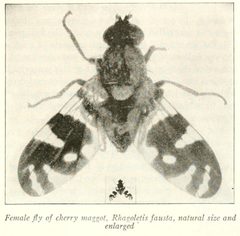
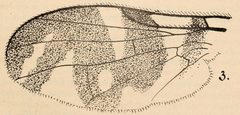
The specific epithet "fausta" and "black-bodied cherry fruit fly" suggest dark body coloration distinguishing it from , though detailed diagnostic features are not provided in available sources. For definitive identification, examination of wing pattern and genitalia typical of Rhagoletis would be required, ideally with reference to original species descriptions or keys.
Images
Habitat
Higher elevation in California have been documented, with specific distribution and patterns studied within the state. plant availability (cherry trees) likely constrains suitable habitat.
Distribution
United States and Canada. Distribution patterns within California have been specifically documented in relation to .
Seasonality
Specific documented in California, indicating defined seasonal activity periods, though exact timing not detailed in available sources.
Host Associations
- Prunus avium (cultivated cherry) - cultivated cherry
- Prunus serotina (wild cherry) - wild cherry
- Diachasma muliebre - Braconid that emerges from of R. fausta
Ecological Role
for Diachasma muliebre; member of fruit fly associated with cherry trees.
Human Relevance
Pest of cultivated cherry crops. Documented as affecting both cultivated and wild cherry trees in North America.
Similar Taxa
- Rhagoletis indifferensClosely related with overlapping distribution in California; studied alongside R. fausta in and distribution research, suggesting similar and requirements.
More Details
Taxonomic history
Originally described by Osten-Sacken in 1877 as Trypeta fausta in the Acidia subgenus. Transferred to Rhagoletis by Coquillett in 1899. Junior synonym Rhagoletis intrudens described by Aldrich in 1909 was synonymized the following year.
Sources and further reading
- BugGuide
- Wikipedia
- GBIF taxonomy match
- iNaturalist taxon
- NCBI Taxonomy
- Catalogue of Life
- The Pan-Pacific Entomologist 88(2)—Penrose Memorial issue | Beetles In The Bush
- Rhagoletis fausta . [Distribution map].
- Distribution and phenology of Rhagoletis fausta (Osten Sacken 1877) and Rhagoletis indifferens Curren 1932 (Diptera: Tephritidae) in California
- Rearing of Diachasma muliebre Muesebeck (Hymenoptera: Braconidae) from Rhagoletis fausta (Osten-Sacken) and Rhagoletis indifferens Curren (Diptera: Tephritidae) Puparia and an Analysis of How the Parasitoid Tracks Its Hosts in a Higher Elevation Habitat in California