
Rhynencina
Johnson, 1922
Species Guides
1Rhynencina is a of fruit flies ( Tephritidae) established by Johnson in 1922. The genus comprises approximately five described , most described by Steyskal in 1979. As members of Tephritidae, these flies are likely associated with plant material, though specific relationships remain poorly documented. The genus is placed in the tribe Myopitini within the Tephritinae.
Pronunciation
How to pronounce Rhynencina: /rɪˈnɛn.sɪ.nə/
These audio files are automatically generated. While they are not always 100% accurate, they are a good starting point.
Identification
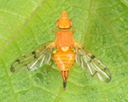
within Rhynencina can be distinguished by features of the , particularly the elongated rostrum suggested by the name (from Greek 'rhyn' meaning nose/snout and 'encina' possibly referring to a pointed structure). Rhynencina longirostris, the type species, exhibits this elongated rostrum. Specific identification requires examination of wing patterns, body coloration, and genitalia; R. xanthogaster has a yellow , while R. spilogaster shows spotted abdominal characteristics.
Images
Distribution
The has been recorded from the Nearctic region, with observations and specimen records from the United States. Specific distribution data for individual varies; precise range limits for most species remain undocumented in available sources.
Similar Taxa
- MyopitesBoth belong to tribe Myopitini and share general body plan and wing venation patterns; Myopites typically show distinct wing markings and are associated with Asteraceae , whereas Rhynencina species lack detailed host documentation and show differences in rostral proportions.
- UrophoraAnother myopitine with superficially similar body form; Urophora possess characteristic wing patterns with dark bands and are well-known gall-formers on Asteraceae, while Rhynencina lacks documented gall-forming and shows different .
More Details
Etymology
The name Rhynencina derives from Greek roots referring to snout or nose (rhyn-) and a pointed or wedge-like structure (-encina), alluding to the elongated rostrum characteristic of the type R. longirostris.