
Aciurina
Curran, 1932
Species Guides
8- Aciurina aplopappi
- Aciurina bigeloviae(Cotton-gall Tephritid)
- Aciurina ferruginea(Medusa Gall Tephritid)
- Aciurina maculata
- Aciurina mexicana
- Aciurina opaca
- Aciurina thoracica(Desert Broom Gallfly)
- Aciurina trixa(Bubble-gall tephritid)
Aciurina is a of gall-inducing tephritid flies distributed in western North America. in this genus induce distinct morphological galls on plants in the Asteraceae , particularly genera such as Chrysothamnus, Gutierrezia, and Baccharis. The genus has been taxonomically challenging due to overlapping wing patterns among species, but gall provides reliable diagnostic characters. Several species are unusually abundant in the southwestern United States and serve as engineers that support complex .
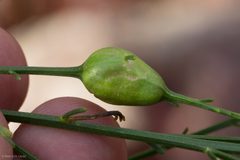
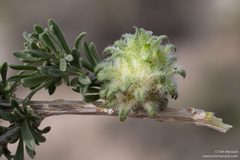
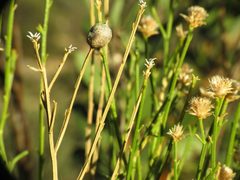
Identification
identification relies heavily on gall rather than wing patterns alone, which has historically caused taxonomic confusion. Galls vary in texture (smooth versus cottony), shape, and plant association. display distinct wing patterns that function in species recognition and courtship. is present: females are larger than males, while males possess enlarged forefemora used in seizing females during mating. Integrative combining gall morphology, host plant , wing morphometrics, and genomic data is recommended for accurate species delimitation.
Images
Habitat
Associated with plants in the Asteraceae , particularly rabbitbrush (Chrysothamnus), snakeweed (Gutierrezia), and desertbroom (Baccharis). Gall formation occurs on buds and stems of host plants. Galls serve as novel microhabitats housing diverse .
Distribution
Western North America, with documented occurrences in New Mexico, Colorado, Arizona, and southern California. Sympatric occurrence of sister has been documented in northern and central New Mexico.
Seasonality
occurs during summer months. has been documented for some , though specific timing varies.
Host Associations
- Asteraceae - plant for gall inductionMultiple including Chrysothamnus, Gutierrezia, Baccharis, and Bigelowia
- Chrysothamnus viscidiflorus - plantfor Aciurina ferruginea; laid in bud exudate
- Chrysothamnus nauseosus hololeucus - plantfor Aciurina trixa in northern Arizona
- Gutierrezia microcephala - plantfor Aciurina trixa
- Bigelowia nuttallii - plantfor Aciurina bigeloviae
- Baccharis sarothroides - plantfor Aciurina thoracica in southern California
- Anthonomus cycliferus - weevil inhabiting A. trixa galls without measurable effect on fly
Life Cycle
are deposited in or on plant tissue, often in bud exudate. The egg overwinters, after which the larva enters the bud and initiates gall formation. Larval development occurs entirely within the gall. takes place within the gall, with in summer. Only one egg is laid per bud.
Behavior
communicate using visual signals, including -specific wing waving displays that function in species recognition and courtship, potentially serving as reproductive isolating mechanisms. Prior to oviposition, females closely examine buds, but not all visited buds receive . Males use enlarged forefemora to seize females prior to mounting; forefemur size predicts copulatory success. Homosexual activity has been observed, suggesting both sexes offer similar visual stimuli to courting males.
Ecological Role
engineers that induce galls serving as for complex multi-trophic . Documented associates include , , and . Aciurina bigeloviae and A. trixa support richer and more complex communities than other documented Tephritidae-Asteraceae galling systems, with 24 across 6 guilds recorded from their galls.
Similar Taxa
- ValentibullaShares Tephritidae and similar mating system with in foreleg size; distinguished by associations and gall
More Details
Gall Morphology Control
Gall is determined by the insect's rather than the plant's genotype, although plant genotype influences whether gall formation occurs. This suggests possible single-gene control of external gall morphology.
Taxonomic Challenges
Reliance on wing patterns alone has caused taxonomic confusion in Aciurina. display overlapping wing patterns but distinct gall morphologies, necessitating integrative approaches for accurate identification.
Research Priority
Galling insects in this and their associate remain under-described, particularly in the southwestern United States. The complete communities of A. bigeloviae and A. trixa represent some of the most thoroughly characterized Tephritidae-Asteraceae galling systems.
Sources and further reading
- BugGuide
- Wikipedia
- GBIF taxonomy match
- iNaturalist taxon
- NCBI Taxonomy
- Catalogue of Life
- Arthropod communities associated with gall-inducing Aciurina bigeloviae and Aciurina trixa (Diptera: Tephritidae) in New Mexico
- Arthropod communities associated with gall-inducing Aciurina bigeloviae and Aciurina trixa (Diptera: Tephritidae) in New Mexico
- REPRODUCTIVE BEHAVIOR AND BIOLOGY OF THE GALL-FORMER ACIURINA FERRUGINEA (DOANE) (DIPTERA: TEPHRITIDAE)
- Response of the galling insect Aciurina trixa Curran (Diptera: Tephritidae) to host plant quality
- Control of gall morphology: tephritid gallformers ( Aciurina spp.) on rabbitbrush ( Chrysothamnus )
- Discovery of a new gall-inducing species, Aciurina luminaria (Insecta, Diptera, Tephritidae) via multi-trait integrative taxonomy
- Life History and Description of Immature Stages of Aciurina thoracica (Diptera: Tephritidae) on Baccharis sarothroides in Southern California
- The significance of sexual dimorphism in the mating system of two species of tephritid flies (Aciurina trixa and Valentibulla dodsoni) (Diptera: Tephritidae)