
Valentibulla
Foote & Blanc, 1959
Species Guides
3- Valentibulla californica(Elliptical Stem Gall Fly)
- Valentibulla munda
- Valentibulla steyskali
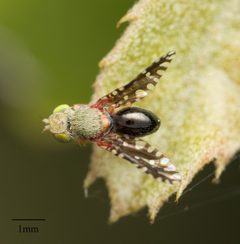
Valentibulla is a of true fruit flies (Tephritidae) established by Foote & Blanc in 1959. The genus exhibits in which females are larger than males, but males possess enlarged forefemora used in mating. Male forefemur size predicts copulatory success. The genus is part of the diverse tephritid radiation, though detailed biological information remains limited.
Pronunciation
How to pronounce Valentibulla: /ˌvælɛn.tɪˈbʌl.ə/
These audio files are automatically generated. While they are not always 100% accurate, they are a good starting point.
Images
Behavior
Males use enlarged forefemora to seize females prior to mounting during copulation. This foreleg-based grasping has been observed in at least one , V. dodsoni.
More Details
Sexual dimorphism and mating system
In V. dodsoni, involves female-biased size dimorphism (females larger in five measured size categories) and male-biased forefemur enlargement. This contrasts with many other tephritids where different dimorphism patterns occur.
Taxonomic note
The was described by Foote & Blanc in 1959. GBIF recognizes it as an accepted genus within Tephritidae.