
Rivellia
Robineau-Desvoidy, 1830
signal flies
Species Guides
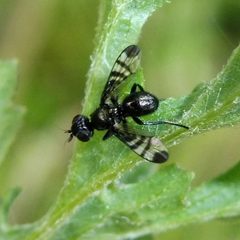
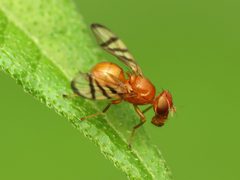
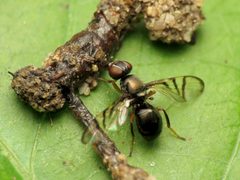
21Rivellia is a of signal flies ( Platystomatidae) comprising at least 140 described . Several species, notably R. quadrifasciata and R. basilaris, are agricultural pests whose larvae feed on nitrogen-fixing root nodules of leguminous crops including soybean, peanut, and pigeon pea. The genus exhibits distinctive wing-waving characteristic of the family. possess tubular mouthparts that give a 'gas mask' appearance.
Pronunciation
How to pronounce Rivellia: /rɪˈvɛliə/
These audio files are automatically generated. While they are not always 100% accurate, they are a good starting point.
Identification
Members of Rivellia can be distinguished from other Platystomatidae by wing patterning used in signaling . -level identification often requires examination of male genitalia; for example, R. quadrifasciata can be separated from the sympatric R. colei only by genitalic dissection. have characteristically tubular mouthparts and wings that are constantly in motion when the fly is active.
Images
Habitat
Agricultural fields, particularly legume cropping systems; also associated with native leguminous vegetation. Larvae inhabit soil and develop within root nodules of plants. occur on foliage of host plants and surrounding soil surfaces.
Distribution
Widely distributed with records from Europe (Denmark, Norway, Sweden) and the Americas; individual such as R. quadrifasciata occur throughout the eastern United States. The genus is likely present in many other regions worldwide given its agricultural significance.
Diet
Larvae feed on nitrogen-fixing root nodules of leguminous plants including soybean (Glycine max), peanut, pigeon pea, and black locust (Robinia pseudoacacia). foods include nectar, honeydew, plant sap, bird droppings, and carrion; males have been observed feeding liquid globules to females during mating.
Host Associations
- Glycine max - larval soybean; major agricultural pest association
- Arachis hypogaea - larval peanut
- Cajanus cajan - larval pigeon pea
- Robinia pseudoacacia - larval black locust
- Desmodium spp. - larval trefoil; likely original native of R. quadrifasciata
- Solanum melongena - associatedeggplant; roots or flowers
- Sorghum bicolor - associatedsorghum; roots or flowers
- Narcissus - associatedroots or flowers
Life Cycle
are oviposited on soil surface near plants, often within 2 cm of the stem and within 2 mm of the surface, frequently in cracks and crevices. Larvae are small, white, and maggot-like, developing within nitrogen-fixing root nodules. occurs in soil. emerge from nodules or soil to mate.
Behavior
exhibit constant wing-waving motion while on leaves, an intraspecific signaling that gives the its . Wing patterning and movement sequence combine to provide -specific mate recruitment signals. Females exhibit oviposition site selection behavior influenced by soil surface conditions and host plant presence; they discriminate against compacted soils and soil lacking host plants, and may retain when appropriate sites are unavailable.
Ecological Role
Consumer of nitrogen-fixing root nodules; larval feeding impairs nitrogen fixation in legumes. Several are economically significant agricultural pests that reduce yields in soybean and other legume crops through nodule destruction and associated nitrogen stress.
Human Relevance
Thirteen are studied in agricultural contexts due to economic impact. R. quadrifasciata, R. basilaris, and related species are recognized pests of soybean root nodules, capable of significantly reducing nitrogen fixation and crop yields. Pest-induced stress from these flies has been documented to cause measurable yield reductions in soybean production systems.
Similar Taxa
- Rivellia coleiSympatric with R. quadrifasciata in eastern North America; distinguished only by male genitalia structure
- UlidiidaeFormerly confused with Platystomatidae under the 'picture-winged flies'; distinct with different and
More Details
Oviposition ecology
Rivellia quadrifasciata females require both plant presence and appropriate soil microhabitat for oviposition. Laboratory studies show minimal oviposition in soil without plants, and significantly greater oviposition in loose versus compacted soil. Short-term responses to unsuitable conditions include retention and increased activity.
Taxonomic history
The has undergone taxonomic revision; Namba (1956) revised North American . Some species were formerly placed in , now Ulidiidae, reflecting historical confusion in signal fly classification.
Sources and further reading
- BugGuide
- Wikipedia
- GBIF taxonomy match
- iNaturalist taxon
- NCBI Taxonomy
- Catalogue of Life
- Platystomatidae | Beetles In The Bush
- Aspects of Larva/Host Relations of the Soybean Nodule Fly, Rivellia quadrifasciata (Diptera: Platystomatidae)
- INFLUENCE OF SOIL SURFACE CONDITIONS AND HOST PLANT ON SOYBEAN NODULE FLY RIVELLIA QUARDIFASCIATA (MACQUART) (DIPTERA: PLATYSTOMATIDAE) OVIPOSITION1
- Biology of Rivellia melliginis (Diptera: Platystomatidae), a Consumer of the Nitrogen-Fixing Root Nodules of Black Locust (Leguminosae)