
Platystoma seminationis
(Fabricius, 1775)
Dancing Kiss Fly
Platystoma seminationis is a small signal fly ( Platystomatidae) distributed across Europe and the Near East, with introduced in North America. are active from May to October and are known for their distinctive courtship ritual, in which males and females touch for 5–15 seconds after a dance of rapprochement. The feeds primarily on nectar and pollen of Euphorbia species, as well as , while larvae develop in decaying vegetable matter and fungi.
Pronunciation
How to pronounce Platystoma seminationis: //plæ.tiˈstoʊ.mə sɛm.ɪˈneɪ.ʃən.ɪs//
These audio files are automatically generated. While they are not always 100% accurate, they are a good starting point.
Identification
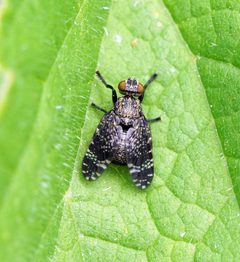
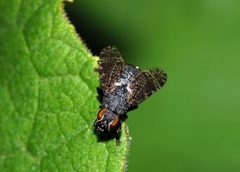
Distinguished from other Platystoma by the combination of black interocular space and epistomes, reddish-brown , greyish , and translucent greyish-brown wings with light spots. The black without punctuation and the specific tarsal coloration (black with reddish bases or hairs on lower side of largest segments) further separate it from . The blackish-brown club is an additional diagnostic feature.
Images
Habitat
Inhabits forest fringes and hedgerows, primarily on low herbaceous vegetation in shady locations. Associated with Euphorbia-dominated vegetation where feed.
Distribution
Native to most of Europe (including Austria, Belgium, United Kingdom, Czech Republic, Denmark, Finland, Germany, Hungary, Italy, Poland, Romania, Slovakia, Spain, Switzerland, Netherlands, Ukraine, and Russia) and the Near East. Introduced and established in North America (conterminous United States).
Seasonality
active from May to October.
Diet
feed on nectar and pollen primarily of Euphorbia cyparissias (cypress spurge), Euphorbia esula (green spurge), and other Euphorbiaceae, as well as on . Larvae feed on decaying vegetable material, mushrooms, and roots of mushroom-infected plants; probably saprophagous.
Host Associations
- Euphorbia cyparissias - food sourceNectar and pollen
- Euphorbia esula - food sourceNectar and pollen
- Euphorbiaceae - food sourceGeneral nectar and pollen feeding
Life Cycle
Larvae develop in and feed on decaying vegetable material, mushrooms, and roots of mushroom-infected plants. Specific details and stage not documented in available sources.
Behavior
Highly developed courtship ritual involving a dance of rapprochement followed by male and female touching together for 5–15 seconds, giving rise to the 'dancing kiss fly'.
Ecological Role
act as of Euphorbia and other plants. Larvae contribute to nutrient cycling through saprophagy on decaying organic matter and fungi. Has been observed as part of pollinator on small flowering plants in agricultural and semi-natural .
Human Relevance
Used as an example in studies of plant-insect interactions and . Its distinctive courtship has attracted scientific and popular interest. No documented economic importance or pest status.
Similar Taxa
- Other Platystoma speciesShare characteristics but differ in specific coloration patterns, particularly the combination of black interocular space, reddish-brown , and wing spot patterns
More Details
Subspecies
Five recognized: P. s. angustipenne Loew, 1854; P. s. bisetum Loew, 1868; P. s. frauenfeldi Nowicki, 1867; P. s. rufimanum Loew, 1873; and the nominate P. s. seminationis (Fabricius, 1775).