
Platystoma
Meigen, 1803
signal flies
Species Guides
1- Platystoma seminationis(Dancing Kiss Fly)
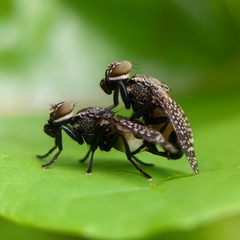
Platystoma is a of small signal flies ( Platystomatidae) measuring 4–10 millimeters in length. The genus name derives from the Greek for 'broad mouth', referring to their characteristically wide . within this genus display complex mating rituals and are distributed across Europe, the eastern , the Near East, and North Africa. The genus is currently in need of taxonomic revision to clarify the status of numerous designated by Hennig.
Pronunciation
How to pronounce Platystoma: //plæˈtɪstəmə//
These audio files are automatically generated. While they are not always 100% accurate, they are a good starting point.
Identification
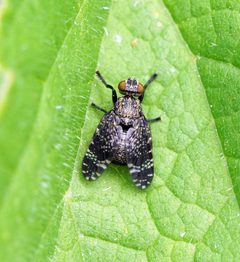
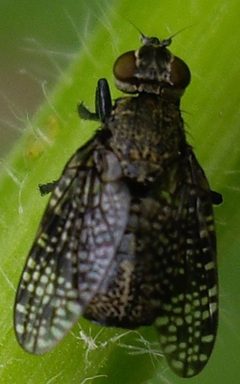
Distinguished from other Platystomatidae by the combination of small size (4–10 mm), black body with pale speckled markings, red , broad , and blackish wings with clear speckles. The requires examination for -level identification due to pending taxonomic revision of .
Images
Appearance
Small flies 4–10 mm in length. Body black with small whitish or yellowish speckled markings. usually red. notably broad, giving the its name. Wings blackish with clear speckles.
Habitat
Specific details are not well documented for the as a whole. Based on -level information, platystomatid larvae have been recorded from rotting tree trunks, bulbs, roots, fruit, dried flowers, dead grass stems, , and fungus.
Distribution
Present in most of Europe, the eastern , the Near East, and North Africa.
Life Cycle
Larval development occurs in decaying organic substrates. Specific stages for Platystoma are not well documented.
Behavior
exhibit complex mating rituals. Detailed behavioral descriptions are limited beyond this observation.
Similar Taxa
- BromophilaBoth belong to Platystomatidae and share 'signal flies', but Bromophila are notably larger (exceeding 25 mm), have metallic blue wings, and are restricted to Africa, whereas Platystoma species are smaller (4–10 mm) with blackish wings and have Palearctic distribution.
More Details
Taxonomic status
The Platystoma is in need of revision to clarify the position of many designated by Hennig. Some subspecies have been raised to full , but many remain unresolved pending further study.
Sources and further reading
- BugGuide
- Wikipedia
- iNaturalist taxon
- NCBI Taxonomy
- Catalogue of Life
- The “buzzard signal fly” | Beetles In The Bush
- Effects of humidity and temperature on ascospore discharge of Graphostroma platystoma in the laboratory and in the field
- Morphological and Molecular Redefinition of Euplotes platystoma Dragesco & Dragesco‐Kernéis, 1986 and Aspidisca lynceus (Müller,1773) Ehrenberg, 1859, with Reconsideration of a “Well‐known” Euplotes Ciliate, Euplotes harpa Stein, 1859 (Ciliophora, Euplotida)